
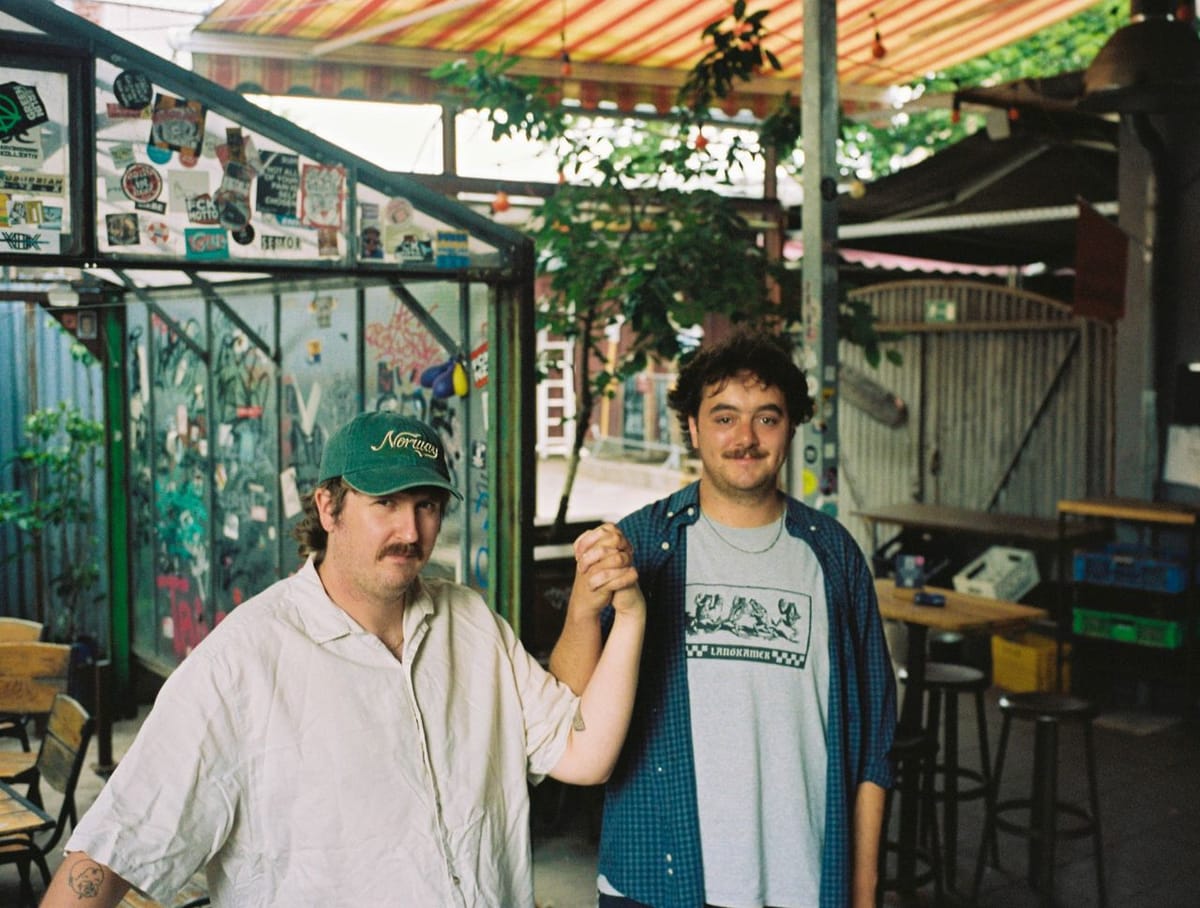
Getdown Services have had a massive year. Josh Law and Ben Sadler have spent much of 2026 on an extensive run across the U.S., Australia, and Europe, playing a string of sold-out dates and bringing their shirtless, sweaty and ludicrous live show to audiences across the globe.
If you have yet to hear any tunes from the Bristol-based duo, their music is an equally strange mix of hyper-specific UK references, witty one-liners and confessional self-deprecation, thrown over a constantly shifting blend of disco, punk, pop and rock, with Josh Law and Ben Sadler often delivering their observations in a dry, conversational style.
Now, you may hear that description and think, “Deadpan humor and niche English references over energetic disco, punk and pop? Seems disastrous.” But there's something about the sheer audacity and charisma of Getdown Services that makes it impossible to look away.
Their upcoming album, Massive Champion, finds them exploring similar soundscapes while allowing themselves to become more vulnerable and sincere than ever before. But they never sacrifice the sense of humor that got them here in the first place. Most likely, they couldn't do away with it if they tried.
I sat down with Law and Sadler to discuss their recent U.S. tour, Live Nation's grip on the American live music scene, the unlikely influences behind Massive Champion, and learning to embrace sincerity without taking themselves too seriously.
Drew @ TND: You recently finished an extensive run of dates in the U.S. in April, your second time touring here after a three-city run in 2025. Now that you've spent more time in the States, what was the biggest cultural difference you noticed compared to touring in the UK?
Josh Law: The driving is enjoyable in the U.S. You guys are professional drivers. Driving is a chore over here, and it's not nice, but you make the roads go through the beautiful bits. You guys like driving; it's a hobby in the U.S. So that was definitely noticeable. The truck stops were pretty exciting, too.
But you do have a big problem with Live Nation owning small venues in the U.S., which is crazy. That was pretty sickening.
That was actually going to be my next question. At the start of your tour, you posted that all the dates were sold out and urged fans not to pay ridiculous resale prices. Is the resale market not nearly as bad in the UK or Europe?
Ben Sadler: It is, or it's getting there. The bigger the venues and the bigger the artists, it's ridiculous, and they've got a monopoly over that. But in the States, it seems like 300- or 400-capacity rooms have been taken under the wing of these monsters, which is quite alarming.
There was someone I spoke to in Boston who worked at one of these venues, and he was like, "I understand where you're coming from," because we slagged it off a bit on the night and had a go at Live Nation. He understood where we were coming from, but he said that they keep the doors open. But it's like, at what cost?
The prices for beer are also outrageous. Ticket pricing can get out of hand, and it prices people out of going to multiple things in a week. It ends up in a situation where they're choosing what to go to, and it's crap.
Josh: It was quite a shock that they own small venues in the U.S. Like Ben said, they have a monopoly on the entire live music industry across a lot of the world, but that's bigger events. So it was crazy to play small venues and have Live Nation everywhere. We were like, "What? This is meant to be a cool show. Why are those guys here?"
I guess America just loves corporations in a way that we don't, or you allow it. I don't know. That was just quite a shock.
Do you think the responsibility for the resale market falls solely on the big corporations, or does some of it fall on fans willing to pay these prices?
Josh: It's really tricky. You don't want to tell people how to enjoy music, but if it comes down to one or the other, definitely the responsibility is on the big corporations. They're the ones being exploitative. People who are being exploited, you can't really blame them.
People who jump to the defense of these big corporations, I kind of think maybe they should be a bit more ashamed. But the responsibility is on these corporations. They're monopolizing, and in America it's been proved to be illegal at times. It's not even legal what they're doing.
Yeah, we don't have a great track record of holding monopolies accountable.
Ben: It's embarrassing, to be quite honest. This thing that's supposed to be an escape and a distraction from the stuff that can really get you down is being lorded over by people who just want more and more and more.
Ultimately, there is a cap on how much a company can have. Money is a finite thing. What's the end goal for these companies? Just own everything, and then what? They're built to grow.
Music only has a certain reach, a certain capacity, and it's supposed to be for everyone. But it's not becoming that anymore.
Josh: I don't blame people. If they're willing to pay it, you don't want to split hairs about that. They shouldn't be paying it in the first place. That's the bottom line.
I don't know if I've ever seen a U.S. artist tell their fans, "Don’t pay these ticket resellers, even if it's coming to our show."
Josh: It's a sort of avant-garde approach to marketing.
Does that same bluntness come across in your music, and is it more about your individual personalities or something cultural?
Josh: In terms of us being in the U.S. and interacting with the U.S., I think there's a thing about being British where you'll never feel more proudly British than when you go to America as a British person.
But I think it's our personalities and the way the band has been formed. We've been able to get this far by doing things how we want to do them and not taking part in things we don't want to take part in. All of that has given us a confidence that maybe verges on arrogance at times. I can hold my hands up there.
We're happy to be outspoken, even at the risk of it affecting the career stuff. We're less concerned about that than we are about speaking our minds. But we try not to be too impulsive because, especially online, you can get dragged into discourse that you don't have the time or know-how to speak about at any length or depth.
If we feel agitated or angry about something, we'll happily put it online. That's not something we get too concerned about. I think that's just our personalities.
Ben: There's an aspect of it just being the British thing as well. I don't think the British audience would blink an eye if a band said, "These ticket prices are fucking insane. Just don't bother." I think most people here would be like, "Yeah, fair play."
But there's something we talk about quite a lot, and that's the American optimism, this positivity mindset, which is really lovely and infectious, but I think can be quite toxic sometimes if it comes to people paying £400 to go to something.
Josh: The American optimism and British pessimism are a bit like oil and water at times. They don't really mix. Something that's probably fairly normal here is quite pessimistic. We just don't realize it because we're all so miserable.
That's a sentiment I get throughout Massive Champion: an acknowledgement of a lot of things that are shitty, but you take it in stride and throw a joke along with it. While writing the album, did you ever worry about tipping too far into sincerity, or did humor naturally become a buffer?
Ben: I think we consciously leaned more into being sincere with this album. That's something we wanted to do, and I think we were more able to do it because we were in a better mental place making this album than we had been for previous releases.
As individuals, but also maybe in Britain as a whole, it's very normal to joke about things that make you uncomfortable to talk about. If something's upset you or angered you, instead of being sincere about it, it's more common for us to make a joke out of it and use humor as a buffer. It's a coping mechanism.
Josh: We've never really wanted to make anything sincere before, so it's not a question we've been faced with. But if it feels right, we'll happily be earnest and sincere.
Sometimes people think we're joking even when we're not. There are sincere bits where people are like, "I love that, it's so funny," and it's like, "I wasn't joking, actually." Maybe that's just our manner.
We've surprised ourselves with how vulnerable things have come out on this album, and you can feel a little self-conscious of it. But I don't think we've ever questioned its place in the music. You feel a bit exposed, but then you go, "That's probably a good thing. That probably means we're challenging ourselves," and you just trust it.
There's still jokes and stuff on the album. You want the album to reflect who we are as people. We're 31, and we're more in touch with our emotions now, but we also still joke around a lot. You want to talk about emotions, feelings and vulnerability, but you also want to joke and try to make it work together.
We never feel like we have to bring some sincerity to a funny bit or humor to a sincere bit. It's just the stuff that's made the album because we trust that it works on its own two feet.
There's a line on the closer, "600 Dance Lessons": "This is Sparta. No, it's not. It's a spliff." That sentiment seems to permeate the record, too: not everything needs to be taken so seriously, and not every situation warrants some grand, profound reaction. Can you talk about that idea a bit?
Ben: It comes down to being more open to exploring your vulnerable side. We're 30, 31 now. My early 20s were just hell. I think back to who I was, how I felt, what I was doing, and I'm like, "Why did I think this trajectory or this person I thought I was being was sustainable or bringing me any joy?"
We're at a place now where, thanks to how well the band's gone, it's given us a bit of mental space to contemplate and process some of those things. Once you're lucky enough to have a bit of time to do that, you reflect on things differently.
I'm really happy and proud that we've been able to face who we are a bit more. That's the angle we were trying to come from.
Josh: I think in terms of the juxtaposition, our previous releases had this confidence in the tone and delivery where we're pointing a finger and having a go. We're attacking things.
Over the past few years, we've started realizing that maybe having this confidence that we know exactly what's right and we've worked it all out is what's stopping us from understanding ourselves.
I think we're accepting that it's all very messy and nothing's cut and dry. You think you understand something, and then there's another part of it that's not what you thought. As you get older, you start realizing you don't actually know anything.
I think this album is trying to reflect that. We don't really know. We've been talking like we know what we're talking about, but we don't really. It's all very messy.
Ben: The things that you feel, the things that you do, coping mechanisms or whatever, you think they're doing one thing, but they're the opposite thing disguised.
Josh: And stuff you think is cool actually is not.
There's a stronger sense of maturity in this record than on Crisps. Your band’s popularity has also grown quickly over the last three and a half years. Has that success changed your everyday life or given you more things to write about?
Josh: The main thing that's changed is the band. The band started as a distraction from working life and all the things that came with it, and just general unhappiness in our circumstances.
The circumstances have changed to an insane extent. So we're not coming from the same place, which means we've got more time. That's the main difference.
In terms of the base level of where the drive and impulse to make music comes from, that doesn't feel like it's changed. It still feels like an impulsive thing where we're just following our nose.
The main thing that's changed is the context around that. There's more time. We don't have to work a normal job. This is us at work now. Talking to you, this is us at work. Before, it was so different.
Whether that's changed the music is hard to know. I don't think either of us feel any less inspired or driven to make music. That's the worry when you start a band and everything you're writing is about your circumstances, and then those circumstances completely change quite quickly. You think, "What am I going to write about?" But that just hasn't been the case.
If anything, we've got more driven because before we didn't have enough time or energy, and I guess money. We record on a very cheap setup, but the freedom that comes with doing it full time is such a game changer and a real blessing.
A big part of this album comes from trying to make the most of that. We always complained that there wasn't enough time to make music, and now we've got that time. We have to make the most of it. It would be a shame to waste it.
Have you had any moments in the last year that felt like a defining "we've made it" moment?
Josh: It's hard to feel like you've made it because we really do live in a bubble. There's not this big team, and the material things around us haven't changed. How we record and how we tour haven't changed, so it's difficult to feel like you've made it.
But there are definitely moments where you're like, "This is beyond anything I could have ever imagined." Even going to America. Neither of us had ever been to the States before, and growing up as a music fan, this idea of doing a road trip or touring in America is really a pie-in-the-sky thing.
When you find yourself actually there, it's bizarre. Those moments are really profound. You can't really process it. You feel like, "This is beyond anything, so we must be going well. I can't believe we're here."
Ben: We played Roskilde Festival in Denmark the other day, and we got to see a bit of David Byrne. We're on the same lineup as David Byrne. That's absolutely mental. I think he's an icon.
Josh: We've been so preoccupied with being self-deprecating, inwardly and outwardly, and with this imposter syndrome for ages. Whenever anything would go well for us, we wouldn't let ourselves enjoy it. It was this weird self-punishment.
We've only recently made an effort to stop doing that. This year we've had a few moments—the U.S. tour, going to Australia, selling out these gigs—and we're taking that on board for the first time.
Ben: I think this is the first year where we've allowed ourselves to put our heads over the parapet a bit. Last year was incredible, but the schedule was so busy. You had to knuckle down and keep your head down and stay in that mindset.
We've had a bit more freedom with time this year, so we're taking each moment as it comes. It's well better.
Josh: I've also got a punchy answer.
A moment where I knew we'd made it was when Anthony Fantano of The Needle Drop listened to "The Radiator" on his livestream, and he nodded his head in approval. I think he liked it. That was the best moment of my life.
The best moment of your entire life?
Josh: Yeah, I've had a shit life.
Ben: A good moment was you were getting out of your overdraft, Josh. That was a big moment as well.
Josh: Yeah, that was massive... thank you, Anthony!
I'd love to get into the actual sound of Massive Champion. It jumps between funk, disco, post-punk, pub rock, and power pop. When you're writing a song, do you consciously try to make it sound like Getdown Services, or does that identity just happen naturally?
Josh: We hope that as soon as we open our stupid mouths, it'll sound like us, no matter what it is.
With this album, we tried to finish songs as much as we could before deciding whether they were going on the album. I think there's just a trust that it'll sound like us.
Ben: Josh is a really, really good producer and has such a recognizable touch. As long as Josh is doing the production, I think it's always going to sound like it's coming from one mind.
Josh: One of the challenges we set for ourselves with this album was trying not to stand in the way of all the different styles we might feel like making. Just lean into it and don't talk yourself out of it before it's done. Find a way to make it work.
It's a fun challenge when you make an album: How are we going to make all these different styles feel like one thing?
Bands like King Gizzard are an inspiration with that, although they kind of do it across albums. Within albums, Beck and Daft Punk do it as well. Hip-hop albums have a similar feeling because they sample from a lot of different sources. The sound palette feels broad, but the through line is the voice, literally the sound of the voice, but also the topics and delivery. That's the thing you hope glues it together.
There's a lot of variety in the influences and soundscapes, but there's still a thread that keeps the album cohesive.
Josh: Thank you. We tried quite hard to make that happen.
Ben: That was one of the main things we wanted to do with this album: have it be cohesive while maintaining that collage-y palette. That's a good word to use.
Speaking of inspirations, sometimes I feel like your influences can be hard to trace. Is there an artist your fans would be surprised to hear is a huge influence on this album or your music in general?
Ben: I don't know if it'd be a surprise because we've spoken about it before, but we both really, really love doom metal and sludge metal. I don't know if necessarily that comes through on this album in particular, but it's a really specific vibe. There's so much different-sounding stuff, so many different-sounding bands and artists in that one genre, but it's all so refined. People may not be surprised to hear that, but yeah, we're big sludge heads.
Josh: The writing of the album had a lot of attempts at doing something like that. Almost some kind of gently heavy guitar sound was in one of the ideas that we tried and ditched. The opening song ended up being folky, but one of the ideas I had for it for a while was a heavy, kind of doom thing.
I'm always telling people we don't get compared to T. Rex as much as we should, considering how much we rip T. Rex off.
We're both much more into rock and guitar music than people might think. For a while, we were seen in this more electronic or disco-y kind of way, and we love that. That's a big part of what we love. But for a long time now, my first introduction to music was guitar.
I'll tell you who one other massive influence on us, for me anyway: The Kills.
Are there any doom or sludge metal bands you'd like to shout out as inspirations?
Josh: The best doom band ever for me is Om. I think they're my favorite band in that world.
Ben: My favorite doom metal album is probably Busse Woods by Acid King. That's just unbelievable. Yeah, shout out.
If someone has never heard Getdown Services before and listens to Massive Champion, what do you hope they can take away from it?
Josh: I hope they get that it's fine to joke around. You can joke around or make a joke out of serious things, and going through life not purposely taking it seriously is a valid lifestyle. That doesn't mean you're not able to take things seriously, though. It doesn't mean you're not a serious person. You can joke your way through life. That’s a valid thing.
I don't know who it is, but there's some famous quote by some guy who called seriousness a disease, and I think we kind of are trying to be like that.
Ben: I think it's a genuinely quite nice thing to realize that we're all just ants on a ball in the middle of space, all trying our best, and that's literally all it is. It's not a big deal.
No one is special, but I mean that in a really positive way. No one is special. Nothing is expected. It's all good. Just calm down.
Massive Champion is out August 14 via Breakfast Records.

What do you think?
Show comments / Leave a comment