
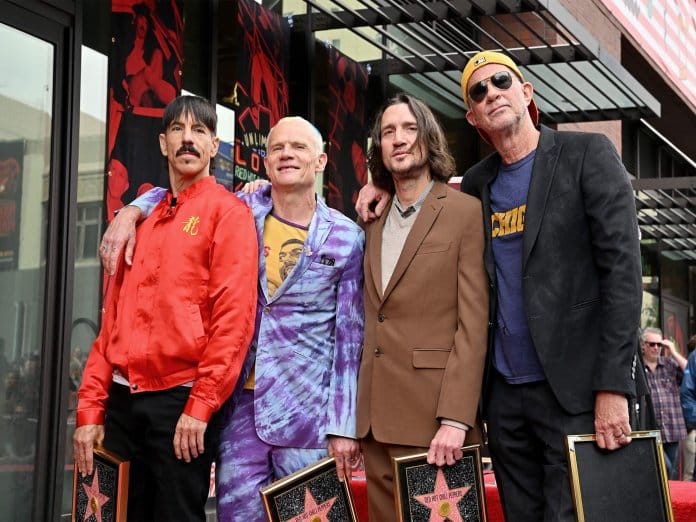
The Red Hot Chili Peppers have officially handed over ownership of their recorded music catalogue to Warner Music Group in a blockbuster deal reportedly worth north of $300 million.
The agreement means the band no longer controls the master recordings tied to every album they’ve released through Warner since 1991’s landmark Blood Sugar Sex Magik. From this point forward, revenue generated through streaming, radio rotation, physical sales, sync licensing, and whatever future format the music industry dreams up next will flow through Warner’s hands.
This isn’t the first major rights deal the Chili Peppers have made, either. Back in 2021, the group sold the publishing rights to their songwriting catalogue to Hipgnosis, now operating as Recognition Music Group, for a reported $140 million.
According to The Hollywood Reporter, the latest acquisition was financed through a partnership between Warner Music Group and investment giant Bain Capital, whose billion-dollar push into music catalogues reflects just how lucrative legacy artists have become in the streaming economy.
And lucrative is the key word here. The Chili Peppers’ catalogue reportedly pulls in around $26 million annually – not bad for a band that once felt like permanent outsiders in the Los Angeles club scene.
What makes the timing especially interesting is that the group isn’t exactly coasting on nostalgia. Their 2022 albums, Unlimited Love and Return Of The Dream Canteen, both landed comfortably in the Top 3 in the US and UK, proving there’s still a serious audience for the Chili Peppers nearly four decades into their run.
Of course, they’re hardly alone in cashing in. Over the last several years, legacy artists have been unloading catalogues at eye-watering prices as music rights increasingly resemble blue-chip assets. Bruce Springsteen reportedly secured around $500 million for his catalogue, while artists like Bob Dylan, Stevie Nicks, Neil Young, Deftones, and Jack White have all entered similar territory.
More recently, Slipknot reportedly sold its catalogue for $120 million, while massive deals involving Pink Floyd, Queen, KISS, Britney Spears, and Tame Impala continue to reshape the business side of rock music in real time.
Meanwhile, the Chili Peppers’ story keeps evolving beyond the balance sheet. Last month saw the premiere of the Netflix documentary The Rise Of The Red Hot Chili Peppers: Our Brother, Hillel, a film centered on the band’s formative years and the lasting impact of founding guitarist Hillel Slovak.
Although the surviving members participated in interviews for the documentary, they also made clear they wanted some distance from the project itself, a typically complicated stance for a band whose history has always been tangled up with grief, survival, and reinvention.
Still, bassist Flea ultimately praised the documentary, calling it “a beautifully made film” that “filled my heart right to the top, not without a good dose of lifelong melancholy.”


What do you think?
Show comments / Leave a comment