
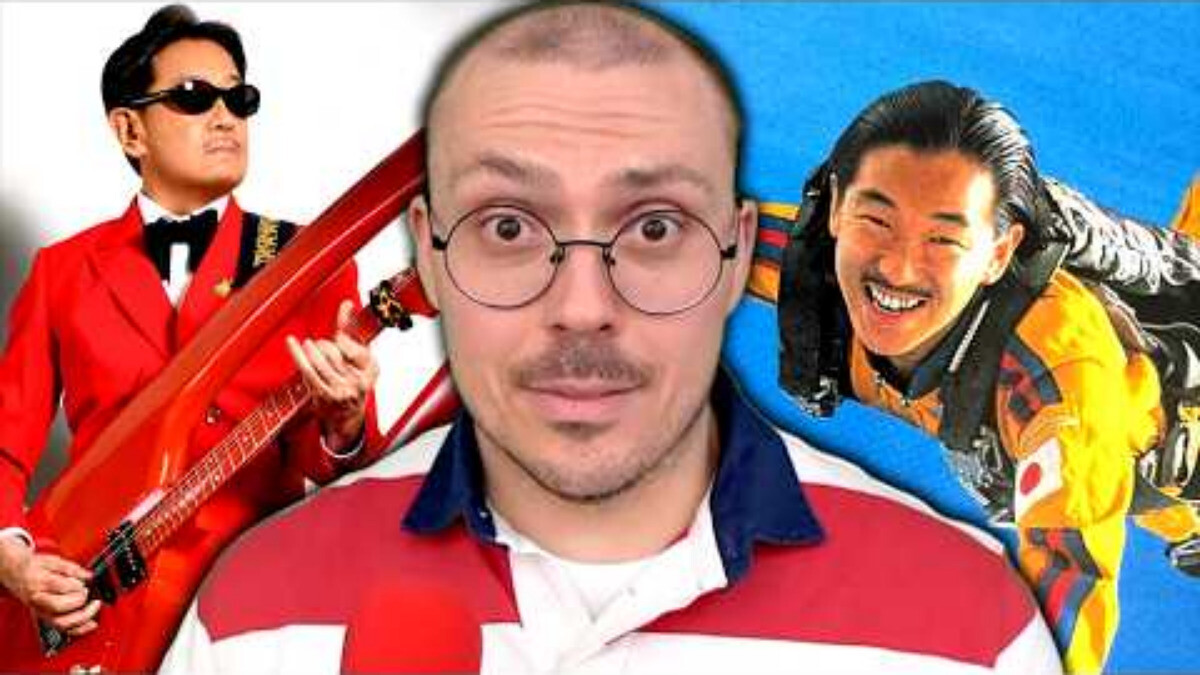
It's real bald hours, y'all. It's time to get bald.
Hey everyone, Anthony Fantano here, the Internet's busiest music nerd. Hope you're doing well. And today we are going to talk about one of the most unlikely comebacks the music industry has ever seen, because right now young music fans seemingly can't get enough of Masayoshi Takanaka.
Masayoshi is a Japanese guitar virtuoso who is currently decades into a prolific career, one that 5 years ago, if you had shown me his most recent output and the state of his audience, I would just kind of say, "Yeah, this guy's run is over; how he fits into modern music history, completely settled."
But believe it or not, 2025 saw this man's first live performances in the US in 40 years and back-to-back sold-out performances in New York City. In fact, the world tour he is currently on as of me shooting this video is sold out, and the guy is suddenly peaking with millions of monthly listeners across all streaming platforms. And all of this coming years after this man has had a hit record.
Now, in doing some digging, I found there are numerous reasons why this guy's music is popping off in a way it never has before. Everything from Gen Z wanting more optimistic music during a time when the world is currently burning, not to mention Masayoshi's subtle influence seeping into decades and decades of video game soundtracks.
But probably the biggest factor in this man's newfound fame is the current gold rush of attention scenes and genres such as city pop are seeing at the moment, which is essentially an era in Japanese popular music, an umbrella term of sorts that can encompass anything from contemporary R&B to disco to boogie to funk, Latin music too. It's music from a period in Japanese history from the '70s to the '80s that saw great economic growth and a lot of cultural positivity. And these city pop musicians were reflecting that with an amalgamation of different sounds. What combination of styles and influences you might have heard on any given album in this style really depended on the artist, on the album itself.
Now, you could say this genre, this era of Japanese popular music, has had at least some influence on Western music scenes for quite a while. Whether it's through artists who have had influence on the scene and crossover appeal over here in the US, like Yellow Magic Orchestra, classic albums like Daft Punk's Discovery pulling a lot of influence from this style. You could also do a whole video about all of the aesthetic parallels between Japanese city pop and vaporwave.
And in more recent years, I have to give quite a bit of credit to Light in the Attic Records for their Pacific Breeze: Japanese City Pop compilation series, which was digging up a lot of these classic artists and albums and tracks way before many of the most popular Japanese city pop playlists were going viral online. And now, as a result of all this hype, not only do I see city pop getting discussed left and right online, but nearly every record store I walk into these days has a dedicated city pop bin, or countless Takanaka records ready for sale.
All of this city pop exposure brings us back to the original topic of this video, Takanaka, because he is an artist who very much stands out in this landscape. After all, within this time period, he achieved massive commercial success in Japan and was widely known for his incredible guitar skills, not to mention all the effortless genre hopping and really well-done covers you can find on many of his albums. Of course, this guy grew up in a family that loved music, pretty much everything that was popular in Japan in the '50s and '60s, but also falling in love with groups such as the Beatles too. Apparently it was the film A Hard Day's Night that inspired him in part to start playing guitar, and as his playing improved, he got into groups that had harder and flashier sounds like Led Zeppelin as well as Cream. He was also a member of numerous bands throughout the '60s and '70s, continuing to improve on his playing and his understanding of music theory. And when one group in particular he was in, Sadistic Mika, broke up, he then decided to start his own group, The Sadistics, with the remaining members of the band, of course. However, it wouldn't be too much longer after this that he would drop his first solo LP.
And it's from here that Takanaka would develop the sound and look that so many of his younger fans are obsessed with now. Whether it be his red suit, his iconic line of custom guitars, which includes one that is shaped like a literal surfboard that he debuted in 2004. I mean, the guy's whole vibe is just ripe for meme-ary because like anything else Gen Z is into these days, it's all manifested into an untold number of TikToks of people pushing and dancing to and celebrating his music. Record stores doing videos where their bins are just entirely Takanaka records. Or skits where customers are coming in and just asking for his albums and that's it, or people dressing up like him, creating their own surfboard guitars.
And look, as much quirk and zaniness as there is surrounding this man, I wouldn't boil what he does down to a mere gimmick because there are some pretty dense, forward-thinking layers of musicianship going into a lot of his classic records, which I think makes it pretty engaging and memorable in an era where we are often, through the Internet, handed all of this algorithmically engineered slop that's just meant to maximize Spotify plays.
As an older music fan, it is fun to go into his back catalog and see how many different unique genre combinations he was able to come up with over the years, and also some ideas and sounds that he was most definitely ahead of the curve on. Like, for example, his second album from 1977, the self-titled TAKANAKA record, where he's wearing that iconic red suit on the cover, considered by many to be a city pop classic and packed with influences from Latin music to dance. It's also a record whose opening moments reads very much to me like the kind of grooves and big band feel that groups like Talking Heads would be bringing to the table in the early '80s. It's such a vibrant fusion of ideas from across the world, and of course, on top of all of this, you have the man himself just shredding furiously over all of it.
Next, I would recommend the album INSATIABLE HIGH, which is also a '77 record. Not only is Takanaka's playing on this one clever and focused and fun, But the horn sections are bright and exciting, and there's a bit of a funkier, bassier, jammier element to this track that are a nice contrast to the more methodically arranged cuts from the self-titled. Also, dig on the super catchy chorus vocals of "E.S.P." — also got to give a recommendation to 1978's BRASILIAN SKIES. This is Takanaka showing off his Latin influences and beach vibes in their highest concentration.
And as a last recommendation, I would also put out there THE RAINBOW GOBLINS album from 1981, his 9th LP. And this is apparently a concept album based around an Italian picture book, and is a really colorful, imaginative, and ambitious record, especially with its narrative setting, which is guided by all of these different spoken word vocal passages that tell the story of the album in between all of these expansive sections of rock passages that are a lot more prog-influenced. And of course, given all the strings and woodwinds too, this record is heavily arranged as well. So yeah, definitely hit those records up.
Now keep in mind, it has been quite a long time since Takanaka has dropped a new album, and maybe his newfound popularity will drive him to do that. But it may not even be necessary because apparently his old catalog is enough to keep new listeners excited. And let's not also forget the fact that this guy's still very much a cherished figure in Japan and has pretty much like an Eric Clapton-like guitar god status and still has so much influence and a legendary career to fall back on. I mean, this dude recorded a whole album with Little Richard that almost nobody has heard of over here, for Christ's sake.
But yeah, hopefully in this essay I accurately explained why everyone's so goddamn obsessed with this guy.
Anthony Fantano, Masayoshi Takanaka. Forever.

What do you think?
Show comments / Leave a comment