
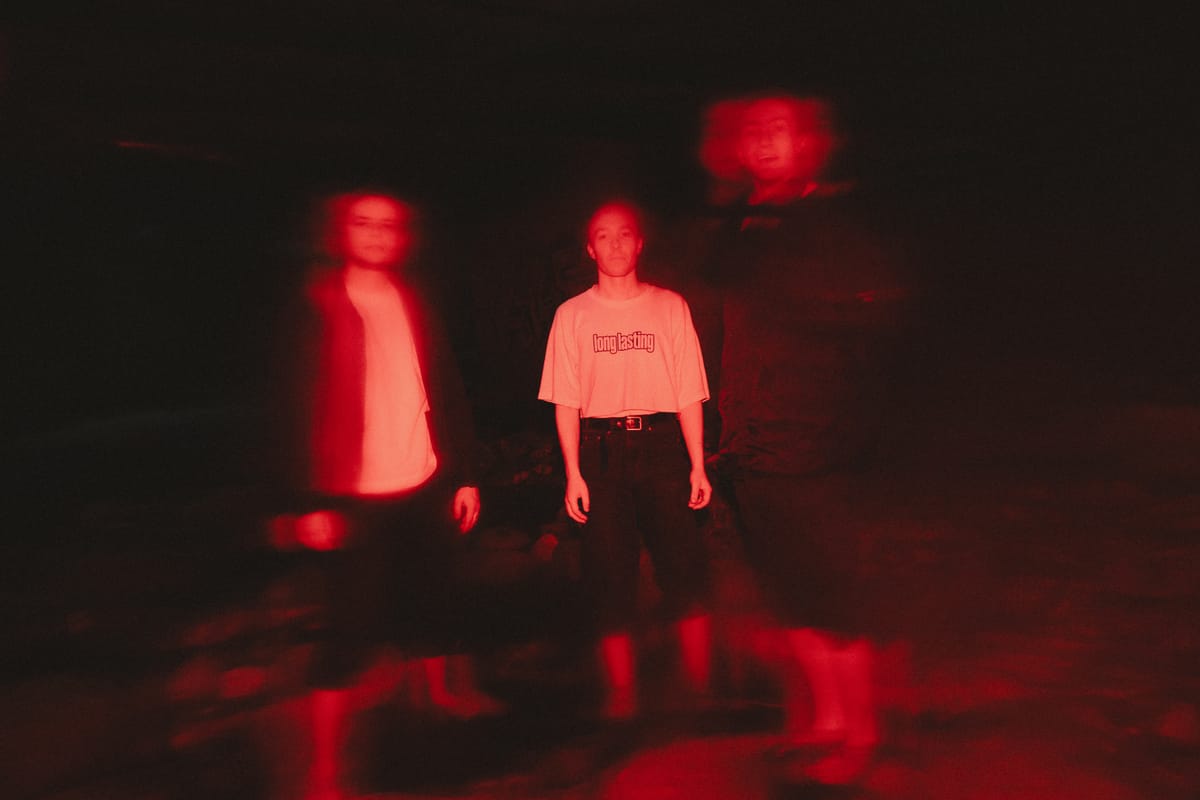
Hammok — the hardcore trio hailing from Norway that consists of Tobias Osland on vocals and guitar, Ole Benjamin Thomasson on bass, and Ferdinand Asaheim on drums — found themselves on their second album, When Does This Place Become Our Scene, stripping everything down to their concepts. "Hardcore," at least for a DIY punk band who started out during the pandemic and had to build their live presence through grassroots means, became a style that emphasized physical movement and community more than anything. More than thrashing guitars and screaming vocals, they envisioned their tracks like "Wall of Death" songs, moments people's bodies could collide and tear the roof away from the building.
The songs on When Does This Place Become Our Scene uphold fluidity, welcoming in the tastes of everyone invited to the party. Drawing from pop, indie rock, electronic, doom metal, and hip-hop, Hammok tasked themselves with finding room in hardcore to capture all their shades and idiosyncrasies. "I’m interested in creating a sonic picture," said Osland in an interview with The Needle Drop. "How can you bring whatever Mk.gee or SOPHIE are doing into the hardcore space? That’s way more interesting to me than getting a really, really cool Meshuggah tone."
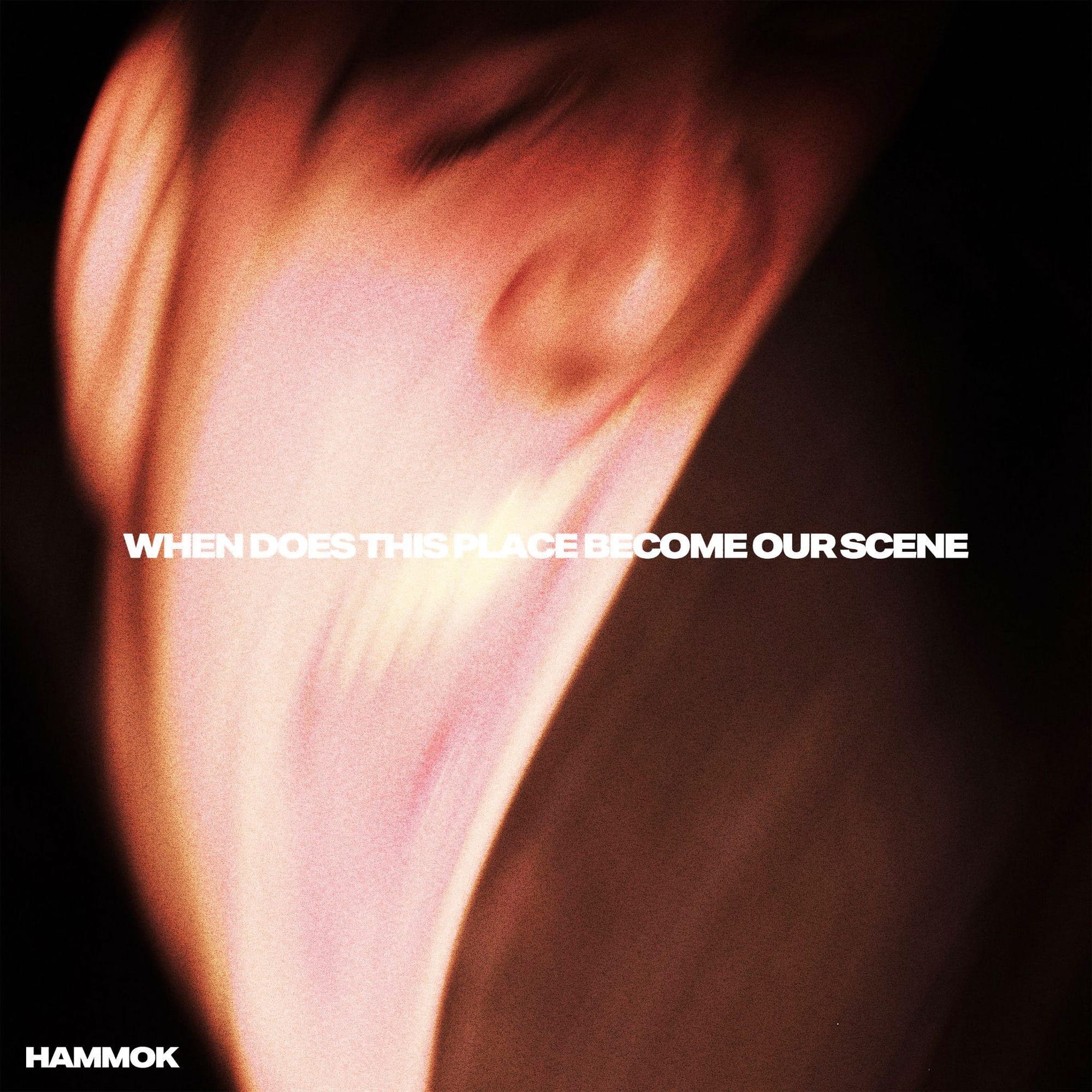
In a way, blurriness of Hammok's new album — captured brilliantly in the warped, grimacing face of someone mid-yell on the cover of When Does This Place Become Our Scene — matches the band's forward-thinking, excited personalities. When asked about the roll-out of their sophomore record, especially when it comes to discussing their Hammok House Parties, they could single out almost every one of the 500+ people they've personally invited to their shows. Cramming 200 punks in rooms capped at 40, the echoing voices of different moods and pitches, the rumbling of their stampeding feet, gives everyone involved their "fix of this underground, hardcore scene," per Osland.
Earlier this spring, I sat down with the trio to discuss their new record, their own take on "hardcore," and the unconventional tools they've used to build a real, intense, and lively underground scene.
This interview has been edited for clarity and length.
Victoria @ TND: I'd love to know more about the story of you guys becoming a live band. Hammok the band started releasing music at an unfortunate time when people couldn’t tour, and even though you've been playing live for years as childhood friends, this record was very much informed by the live experience as a serious, touring band. How has transitioning into a more traditional, this-is-what-a-band-is-supposed-to-be role changed your perspective on music?
Tobias Osland: We didn't start as live performers. I feel like most of what’s been going on in my head was like, “Can my voice handle doing this stuff night after night? Is this song possible? Can this happen? This music we're writing — is it too technical? Is it going to move people?” Then, after playing shows, those questions morphed into becoming the whole point of our music: moving people, meeting people, and creating live energy. Having conversations eye-to-eye: it’s a classic hardcore thing, but that's what makes it real. That experience was super inspiring for the new album, which I don't think was the case for the first one. It’s kind of meta, but our first album was just about the need to have a first album. This one, however, is very focused, and it's rhythmic in a way that hopefully makes people move. And so far it has!
As opposed to more traditional hardcore and punk records, the songs that you've provided are quite long, and they go multiple directions. I really liked “Tap Water” because it starts off with this indie rock feel, and then it abruptly stops before starting again as a punk track. When it comes to writing a song and delicately blending these genres together, how have you pulled in all these elements to make a song?
TO: “Tap Water” is very much a result of listening to new music all the time. I’m pretty much waking up every day finding something new and being inspired by pretty much everything that I hear at all times. But I also try to be careful; instead of hearing something and thinking, “Oh, I'm going do that thing that I just heard for my song as well!” I’m trying to take the concept of that instead. For “Tap Water,” I remember hearing a Militarie Gun song and going, “Oof, I love the vibe of this song!” Breaking it down to its concept, it’s like this Arctic Monkeys AM song with a tempo and mood that’s full of character. I’ve gotten obsessed with not exactly copying but writing in the concept of what's inspiring you.
A good example would be that everybody’s copying the Mk.gee tone, but they’re missing the part of it that makes him cool. He asked what happens if you don’t plug a guitar into an amp and then made a bunch of music centered around the character of a guitar. It’s like taking the concept of a dubstep sound — what makes a song “dubstep” — and putting it in a different space. I feel like asking these questions makes things more of a true songwriting process, not just stealing in a bad way.
Right, there is a huge difference between taking inspiration from someone and being a derivative. I feel like it’s especially noticeable with Mk.gee, where there are artists who love the moody, icy sound and spin it to fit them, and then there are others who…well they just want to make a Mk.gee album. And spend the whole day in the studio trying to replicate his exact guitar tone.
TO: It’s so fucking obvious, by the way; run your guitar into a cheap sound card and crank the input. There you go.
To me, it’s the concept behind these production tricks that is so interesting. Like, what Dijon is doing with his sound is so interesting, and it’s so unique to him. I wouldn’t want to fucking touch that. But, I think the concept is groundbreaking and feeds new creativity.
Even though it's one of the shortest songs, “When the Kids Are Too Old to Cause a Scene” is, in my reading, the album’s centerpiece. It has this strong hook of, “Live through me!” I was wondering if you could explain the history of the song, how the music came together, and how the lyrics and that hook came to be.
TO: I remember the demo was called “Real Punk Song” because I knew we couldn’t only have these smart, hardcore-adjacent songs. We needed something real. The instrumental came along pretty quickly; the intro riff was Nirvana-esque grungey, and then the heavy part folded into a classic hardcore song.
We once played a show where some older guy from our hometown wanted to sing a song with us on one of our tracks. He grabbed the mic on the stage and just did the vocals for a song. His whole thing is like, “Yeah, you guys are young. I'm old and done, so I'm gonna live through you guys now. If I can come up on stage and do a song, I'll do it any day!” That stuck with me; when you play Norway, and you play rock music, a lot of older people show up because old people in Norway like rock. Young people don't care as much. Every time you play a show, some old guy comes up to you and says, “Yeah, you remind me of this band from the 90s, as well as this band, and this band,” etc. So, that's very much present in my mind.
The song, then, needed to find a humorous way of making fun of the old people in the crowd. Like, our friend is 40+ years old or something; I was just imagining singing it to him in this kind of mean but also funny way. (I also played the whole song for him and showed him the title, and he thought it was really funny.) I was just trying to have fun by myself and feed into the whole ecosystem of the album.
Ole Benjamin Thomassen: The funny part is that his whole personality is music. Like, he looks like the dude who's definitely going to start the pit — with his tank top and everything. But he's old, and he can't do it as much anymore, so he lives through us.
TO: But he also knows this as well. He's not trying to be super, super young and do the whole band thing. He has a child. He has a job. He needs to renovate his home, probably. He's good, you know?
It was also, like…We need to have some fun songs. We need to have something that we can play eight times in a row and have it go off every single time.
OBT: It's our “wall of death” song. With our friend in the middle, of course.
I’m not from Norway, so I don’t know much about what you’re trying to say. What about young people do you think has pushed them away from rock music? Where does that sense where you feel like it is more older people who are holding onto it coming from?
OBT: I wouldn’t say that all young people have gone away from rock music; at our latest shows, a lot of younger faces have starting coming. We’ve just found that, usually, people who show up for a totally unknown band are the older ones with money to buy merch and a ticket. In general, the music scene for young people in Norway is like…If you are a regular person living in Norway, you are fed party music. That’s a whole cultural thing. It's only the weird kids who listen to rock, you know? Everything is much smaller for younger people to take part in something. Norway having 5 million citizens or something makes the niches pretty small.
TO: I think that, combined with rock music being very legacy focused in Norway, the main rock genre for us here is this Scandinavian style of rock music that’s slower, glam rock with some screams sometimes. But like… low screams; it's not high pitched nor angsty. But I do think, like, the stuff we've been doing the past months — doing house party shows where we personally invite every person through a video invite that says their name, spoken out loud — we're getting all the young people interested in alternative stuff in Oslo to show up. I think the last time, we sent out 210 invites for that show, and the venue cap was 40 people. By packing these spaces, I feel like people are getting their fix of this underground, hardcore scene. And it’s nothing you’ll see at one of those big company-run rock festivals where you have Green Day, AC/DC, Limp Bizkit, where they’re able to sell a lot of tickets and appeal to a broader audience in Oslo. We're just doing a completely different thing from that, and that's been really engaging with lots of different alternative kids, even internationally.
I am curious to know more about the way that you guys have been promoting yourselves online, mainly because the internet becomes its own kind of character in the album, in a way. You’ve been mainly personally inviting people to house parties and reaching out through online platforms, and you’ve been using it as a tool to connect people in person rather than just digitally. How does that fit into your perspective about the way music works with the internet and this new era of trying to build a scene?
TO: It’s hard to do stuff on the internet without feeling like you're betraying yourself and your personality. It can easily feel corny, or fake, or like selling out — especially with the ways industry pop writers now make music for trends and “sounds” or whatever. Chasing algorithms does not make you happy; it does not make you inspired. It can be fun to get some likes from time to time, but I think we found the house party shows that completely bypass the algorithm works effectively. Just going straight to people and sending personalized messages about unofficial events the three of us put on…I mean, we pulled 70 people in four days for a show in Oslo. And in Oslo, that is insane. You can promote an official event for months but still get fewer than that.
I'm saying people’s name in each invite. And it’s a disgusting amount of work, but honestly, going straight to people is going to be a huge thing again. I just saw a James Blake interview where he was talking about his new album and his new approach of sending newsletters directly to fans. You don't have to be a streaming artist or chasing algorithms; you can actually cater to these smaller groups online and hopefully grow that organically. So, when you send them an email, some people will always show up. They're invested in a truer way, more in the way when you buy an album on vinyl — you have like a piece of this band, you are a piece of this band. It's a dialogue that's personal, and I know who these people are. And when they get our invite, they’ll hopefully think, “Oh yeah, they want me here! They think I'm cool.”
OBT: This approach definitely feels more like you’re knocking on their doors and saying, “Just come join us!” instead of screaming out to a huge audience. It's even hard to be the one to listen to the person who tries to scream out to promote a big show. Everybody's screaming, you know; there's so much noise on the internet and everywhere, actually. So, yeah, doing the direct approach has been very different.
TO: To bring you to a political place, and since you're in New York, watching the Zohran Mamdani campaign from Norway, we got the idea that he's invested in grassroots, real campaigning. Like, show up and talk to people, and they’ll connect with you from a very honest place. I think the same goes for growing the music community online; be as direct as you can be. We're going to be bringing shows more through Norway this year, collecting names as we go, and by the time we're (hopefully!) playing New York, we will have made 500 fucking personalized invites. This can blossom into a whole thing, and other bands can take the concept and do cool shit with it. That makes it culture, and that makes it identity.
The very important part of this project is that there is a location, and that it all goes to somewhere. It isn't just like, “Here's my new song!” (Although, sometimes you do have to do that because you needed recorded music.) I remember playing “The Scene” at our first house party, and it was insane because I realized I was playing this song for the first time in front of people, and it played exactly how I hoped it would when I wrote it. This was the image I had in my head when I made the song and wrote the line, “When does this place become our scene?” Like, before there was something we missed and didn't have in Norway, but after two shows with this house party thing, it's getting somewhere. Like, it feels like we have started the community already.
OBT: It's a really fun thing. In this genre, I've noticed that it doesn't matter how many people show up; it’s more how the audience reacts to the music and how they play off the energy that we give them. We played a show at this huge festival in Norway a couple years back, and there were 6000 people there. That itself doesn't necessarily mean it was a really cool and good show. In fact, these house parties with 40 people felt more real than that. More intense, in some ways.
Another track that I wanted to focus on is the longest track on the record at almost 5 minutes: “Groundbreaker.” That one, I think production-wise, is the most interesting on the record. I love the very, slow ending to it where it fades into a heartbeat and takes a final breath after all these other, thrashing, yelling, high-energy tracks.
TO: The beginning of the songwriting was kind of funny on this one. I was listening to the artist Labrinth, who I think is cool and has a song called “Earthquake” that was a huge hit in [2012]. I was obsessed with the intro, where he goes into a cool flow and says, “Ladies and gentlemen / This is something they call a ground-breaker.” And I was like, So, I just started ripping off the intro, building it with the whole drum beat and the guitar. I still don't know what the hell “groundbreaker” means, but it has a really good, powerful feeling — it’s a strong word.
I think we worked on that song for a very, very, very long time. At first, the slow ending was not there at all. At that point, we had pretty much everything except for the drums, which were the only parts we wanted to record in a professional studio. We made a rough outline of the ending, and we ended up recording a bunch of double bass pedals. It was this whole thing.
OBT: It was such a bird’s nest. A nightmare.
TO: I sat with it for so long, and I kind of just gave up trying to fix it. Then, by some weird production mistake, I ended up making that huge explosion — the thunder sound that is pretty much the base for the whole ending. I didn't want to work on this song anymore, so I just put that sound four times at the end of the song and bounced it. I listened to it the day after and thought it was kind of cool…Can it last twice as long? 10 times as long? After putting a kickdrum under it, we started building out this whole new world, and that thunder sound is the groundbreaker.
The song does a lot of things throughout its long runtime. It's chaotic, and it has probably the biggest vocal stack of the album — just lots and lots of layers. By the end, it just feels like everything is shaking around you. The slow heartbeat sits perfectly in the middle of the album, by the way. It caps off Side A on the vinyl. There, you have to take a beat. It feels very much like that first half chunk of the record now has to stop because I can’t take it anymore. This is our Nine Inch Nails moment. We need to make it big; it needs to feel fucking terrible. When it's over, you need to say, “Thank God, that's over!” It feels like a really strong point where you can stop and close the chapter…And then “Tap Water” builds you up again, and we start the journey of the second half of the album in a brighter place.
Did you imagine sequencing the record as if it were on vinyl first? Because I do think that it is a really nice segmenting of: “Groundbreaker” ends, pause, flip, and then slowly gain back the full energy.
TO: Mostly what you're hearing on the album are actually the demos, except for drums. The album became a cool, mixed fidelity type of thing: guitars, bass, and vocals that are recorded in a very lo-fi, bedroom way blended with these giant rock drums recorded in a big, professional studio.
Ferdinand Aasheim: I would say it's the most fun we've had recording drums ever. Since it's usually been just in a rehearsal space with same drum kit and doing the best production you can around it, it was amazing to work with three drum sets with different set-ups in four locations. We changed a lot of snares.
TO: “Groundbreaker” was probably always that at that spot somewhere in the middle of the track list; I always thought of it as the end of “Side A.” I don't think I ever actually said that out loud to the label, however, so I was very relieved very relieved when it ended up that way.
We were working with our SoundCloud demo order, so we could listen through the whole thing as many times as we wanted. “For My Friends” was specifically written because we needed a closing track, and we were being meticulous about the intro to begin the album’s overall story. We also have the idea that the second-to-last track is always the spiritual last song, and then the actual last song is the credits. We liked putting some frames around the songs and looking at them from a distance, setting some boundaries…Because you can go forever if you don't have any boundaries.
OBT: Yeah, and that SoundCloud link with the demos are basically what Sargent House heard that made them interested to support us. They heard the whole album, roughly, before we even recorded it.
FA: Yeah, I love to think that we have the best demos in the world.
TO: I think that’s actually true, because they are fucking insane! They sound great. The demos are always almost the full song. I didn't even re-record the vocals for “Blast Off (Blast Off) Blast Off.” That's the first-ever performance of that song, sung into a cheap-ass mic just shipped off to mixing. I love that having the first-ever performance on an album. It's usually the best one: you're not tired, you're not annoyed, you're not trying to be perfect. A lot of the guitars are super rough as well.
OBT: It just feels like the best because artists often think that the demo is the best. Mostly because it’s the closest to what they imagined the song to be. So if you get some of the demo on the actual version, it pleases your brain and hopefully also sounds good to the actual listener. Both parties are happy!
Something that I found interesting about Scene is that — even though it is operating in this hardcore sound that's trying to sound as live, raw, simple, and visceral as possible —you do incorporate synths, pop punk production, and elements of indie and alternative rock. When “What even is hardcore anymore?” became such a debating talking point about purism and evolution in recent years, how’d you end up deciding to go for a hybrid sound that pays homage to its roots but also evolves into a different direction?
TO: I think it's always going to be the color — or the general vibe — of whatever hardcore is. That energy and performance style will always be there because that's how we all were raised. That's the first thing that defined what we do. But in production and in sounds, it's always about creating that moment by yourself where you feel like your feet are not on the ground anymore. If you can create these moments in the song of huge energy or huge relief, but from a place that feels out of balance or coming from a different world, I think that’s ideal. Tyler, the Creator is a great example of creating moments musically. For me, that happens when you realize the production is a huge part of the song. For example, is the song speaking to 100 people or one person? How would that affect how you process the vocals? How much reverb you put on the drums? I'm never really thinking about it when I'm doing it, but it all guides the song, and you're performing the song through production, I think. I see it as this web of sounds and experimentation. Just record everything, commit to everything, do everything all of the time. And if one of those things ends up sounding really cool and important, then you can build, and build, and build, and build.
I’m interested in creating a sonic picture — like, how can you bring whatever Mk.gee or SOPHIE are doing into the hardcore space? That’s way more interesting to me than getting a really, really cool Meshuggah tone. That’s not what we do.
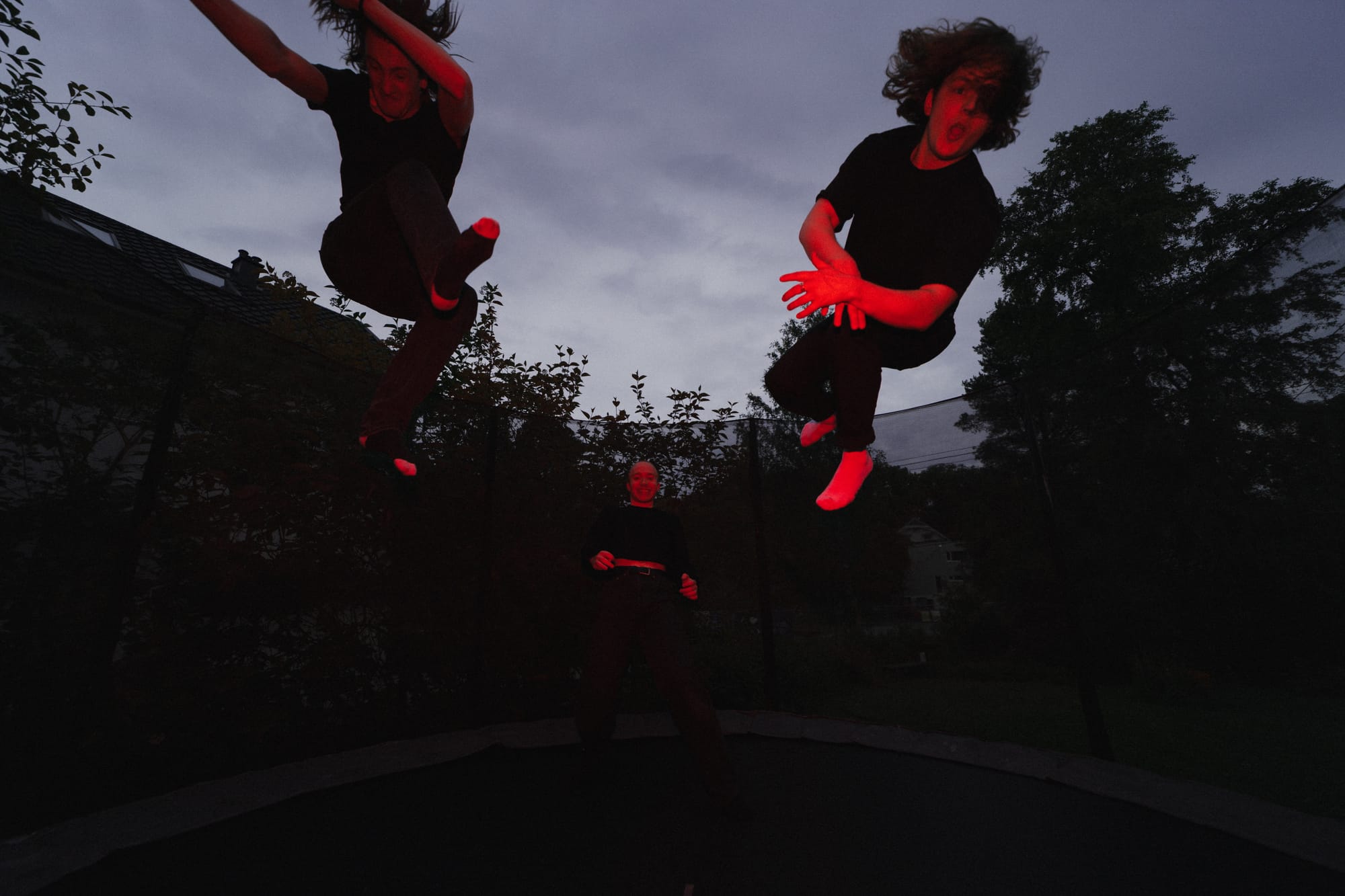
When Does This Place Become Our Scene is out now via Sargent House. Stream/order it here.
What do you think?
Show comments / Leave a comment