
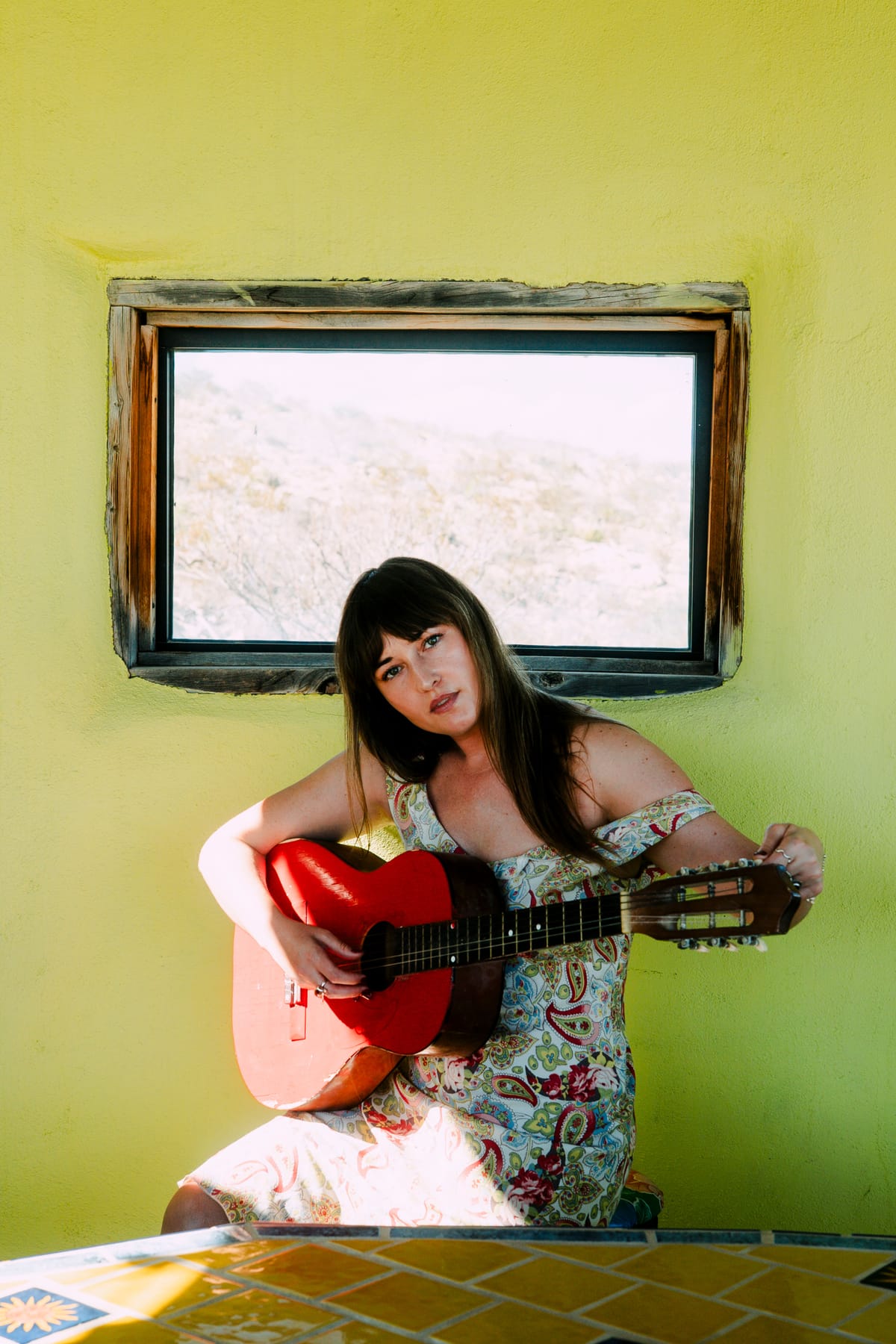
Jess Williamson is not easing anyone into A Mile South of Heaven. The new record, which came out October 9 on New West Records, is easily her boldest, most introspective journey yet. Bringing in classic country instrumentation like pedal steel, fiddle, and banjo at the center, while trusting Shooter Jennings to steer the metaphorical ship at the legendary Sunset Sound, what comes out the other end is a record of reflection, collaboration, and a demonstration of a strong songwriter at work.
The Texas born singer-songwriter has a repertoire of influences to be proud of, and isn’t afraid of collaborating on this record and reflects on the beauty of letting other people do their thing freely.
Around the album’s release, Williamson shared a video for “Hum of the City,” directed by Rocco Rivetti, and played Austin shows including ACL Live with Brandon Flowers, Austin City Limits Festival, and an album release show at The Continental Club. In January, she heads out on a headline tour beginning in Saxapahaw, North Carolina, and running through February 20 in Los Angeles.
I had the chance to chat with Williamson about A Mile South of Heaven, loving the journey and falling in love with the romanticism of making music, and trusting yourself along the way.
This interview has been edited for length and clarity.
Matt @ TND: Now that we're about two weeks into the release, what's surprised you most about how people are hearing the record?
Williamson: Honestly, I didn't know what to expect. I was really proud of the album, and making it the way I did felt like a confident step into working with more classic, traditional instrumentation. But my last record had some more pop textures, and that brought a lot of new people to my music. So I had this question mark about whether they'd stick around for this one. It's such a songwriter's album, where so much of it is about the storytelling and the world-building in the lyrics, and I wasn't sure if people in 2026 are here for that or not. The last two weeks, I've been so pleasantly surprised, because I feel like people are connecting. That feels really good.
"Dark Day in Dallas" came out of a writing retreat with Courtney Marie Andrews, Lola Kirke, Cornelia Murr, and Katie Pearlman. How does writing alongside other songwriters differ [for you] from writing alone?
Writing alone is sometimes like beating my head against the wall, and sometimes it's like turning on a fountain and it just flows out and you have a song all of a sudden. "Goodbye to All That" came really fast, in an afternoon. Sometimes you're channeling it from somewhere else, and you just need to catch it before it goes away. That's the best when that happens. Then I have songs like "The Gem and Mineral Show," which I was tweaking across years.
"Dark Day in Dallas" I actually started writing over 10 years ago, when I was still living in Austin. I was alone in my house one night, and I'd just had this really long, sweet phone call with my mom, and I got inspired to write a song about her. I wrote the first line, which is "I remember how you worked like money could save us / And how you weren't so wrong about that." I started the song that night and never finished it. I think it's such a personal and important topic that I had a block around finishing it for years, literally over a decade.
Then Lola invited all of us to upstate New York last summer, and we ended up writing a bunch of songs together. It was very organic. I think no one really knew what the goal was. It was just: let's see what happens. On the very last night, we were sitting around drinking wine after the most magical week, and I said, "I've had this idea for so long, and I've never been able to finish this song." Cornelia had hung out with me and my mom before, and [my mom is] a really special, cool lady, a legend of a woman, and Cornelia was so taken with her. So I said, 'I have this lyric, and I've been trying to write this song about my mom," and we wrote it that night. We were all crying because we were all thinking about our own moms. They took my story and put it into lyrics and this beautiful melody. I don't know if I ever would have written that song without them.
Collaboration's amazing. It's so helpful to have somebody to bounce ideas off of and help you put words to your own story.
How do you hold onto a lyric for that long? Are you a notebook person?
I'm a notebook person. I'm also an iPhone Notes and voice memos person, which is the songwriter's best friend. But honestly, that lyric just stuck with me, I think because I liked it so much. I was always trying to do something with it, and it was one I just remembered.
What did Shooter Jennings push you on that you wouldn't have pushed yourself on?
Shooter has such a cool and subtle way of bringing things out of the people he's working with. One of the things that meant so much to me is that he did not encourage me to edit my songs and make them shorter or more palatable. "Hum of the City" is a longer song, about four minutes, which in this day and age is really long. I remember saying to him in the studio, "At the end I'm repeating the chorus again and then doing this tag, maybe we should cut that in half." And he said, "No. I like it." In that same song, there's a bridge that goes really high, with the conversation with the bartender where I'm asking him to play some old country music. Initially I only had that in there one time, and Shooter said, "I love that. I want to hear it again."
He had this way of appreciating things about the songs I brought in and pulling out what he liked, and it was often the things I was insecure about, like thinking, is this going on too long, or am I not sure about this section. He'd say, "Not only do I like it, I want more of it." That kind of stuff is really helpful in the studio. There are also no bad ideas. Any idea I had, we'd explore, and even if we didn't end up using it, he'd make time for it. He never made me feel like I was too much or overthinking things. It created an atmosphere of experimentation and play that was really comfortable.
When I first met him in Sunset Sound Studio 3, which is this famous, special room, I was nervous, driving down Sunset Boulevard and pulling into the gates and seeing the famous Sunset Sound sign. But as soon as I met him, I was completely at ease, because his energy is so grounded and calm, and he's not an intimidating person. He just loves music. He actually sees the best in people, and he made me feel comfortable to just be myself. I think a good producer brings out the most "you" thing in you, and that's what people are going to connect to.
Did working at Sunset Sound change what you thought was possible for your music?
Yes. Being in a room where Prince made albums, and where so many albums that I love were made, opened my mind to what is possible for my music. I came up in a world of indie music. I self-released two albums, very DIY, then signed with a really cool Brooklyn indie label, Mexican Summer, and put out three albums with them. When I started making this album with Shooter, I didn't yet have a record deal, and I didn't know what was next. Being there made me feel like anything's possible. Let's just follow the songs and not limit where they can go, not say, "This is going to fit into this niche of music." Let's take all that away and do the best for these songs. I was working with people who are comfortable playing all different kinds of music, where certain things that seem like big dreams to me are kind of normal to them. I could trust that I was in good hands and it was going to be a great album.
Just getting to go to work every day at Sunset Sound and eat in this awesome studio with these talented people, I felt like, this actually is making it. It's a dream come true. Regardless of how people respond to the record, getting to make this album this way, with so much care put into my songs, is the reward in itself.
A lot of records made today, and there's nothing wrong with this, aren't made in a very romantic environment. It's a lot of computers and MIDI keyboards, plugging a guitar straight in and putting an amp preset on it. That's fine. There are a lot of great records made that way, and I've made records using some of those techniques. But the romance of sitting inside Sunset Sound with five musicians, Shooter Jennings, and three engineers, there were moments where I thought, when I was a little kid and dreamed of being a musician, it looked like this. People aren't making albums that way as much anymore, because there are cheaper ways, and it's sort of getting phased out. So the romance of it was not lost on me. It felt like a movie.
"The Gem and Mineral Show" connects Jack Antonoff naming one of your songs his most-played track of the year with meeting Taylor Swift at a Grammys afterparty. How did that happen?
It was the day a lot of people were posting their Spotify Wrapped, which people don't do as much anymore. This was 2023. Jack tagged me on Instagram with a screenshot showing that my most-listened-to song of the year for him was "Hunter," and wrote something really nice about how much he adored it. He didn't follow me, I didn't follow him, and we'd never met. I was so surprised and flattered that I slid into his DMs and thanked him.
A few weeks later, on the day of the Grammys in LA, he sent me an invite to an afterparty he was having at the Chateau Marmont. As a woman, it's hilarious to get an invite like that a couple of hours before, because I'm immediately like, what am I going to wear? Of course I'm going. I grabbed my nicest dress from tour and went by myself, because I didn't know if I could bring anyone. It was a totally surreal night. I'd been watching the Grammys on TV while getting ready, seeing Jack, Taylor Swift, and Lana Del Rey at this table and thinking, "I'm about to go to their party."
I was nervous people would be rude, because I'm not a famous person like they are, and it was actually the opposite. I think in a situation like that, people are extra nice because they think maybe you could do something for them. I did get to meet Taylor that night, and she was just as kind as everyone says. When you're talking to her, her attention is on you and you alone, and I wasn't expecting that. It was a really magical LA dream of a night.
The song is actually about this dual-world situation, because not long after, my dog died. My boyfriend and I buried her in Terlingua, Texas, about an hour and a half outside of Marfa, where his family has some land and a cabin his dad built in the 1970s. I was going down there a lot to visit her, plant cactuses, and leave candles. One day I was driving through Alpine, Texas, and they were having the annual gem and mineral show. I decided to check it out by myself, and as I was looking at all the crystals. I thought about how I was a tourist there. Then I started thinking about the party at the Chateau Marmont and realized I was a tourist there, too. I dipped in for a night, but those weren't my friends and it wasn't my community. I was nervous and probably overdressed, and it felt like I was dipping into a place that wasn't mine. That stuck with me, feeling like a tourist in both places. Also, kind of trying to get ahead of the insult, because it's an insult to be called a tourist, especially at a party.
What was it like to put the loss of your dog alongside that story?
For me, it's about fantasy versus reality. Something I've struggled with is having big dreams and being ambitious and wanting to become an artist. Those are all good things, but the shadow side is that you can, at times, lose sight of what's really important. That night was catnip for that side of me. I was thinking, "Oh my gosh, I'm here, I'm where I'm meant to be, soon I'll be best friends with Taylor Swift and we'll be collaborating." I was creating this whole story in my mind that I'd made it because I went to one party. None of that happened. That's not how the story went.
Instead, it was something very personal, private, and small in the world's sense: my dog. That's just mine. Having that profound loss, because I think a lot of people who love dogs understand that it really is a big loss, and then being in Texas with my boyfriend and my community in Marfa, who all knew my dog and were so sweet about it – going from this big, sparkly night to a small, sad, private grief pretty quickly. It was a good perspective-shifter about what's really important.
The big question I'm asking in that song, and throughout the record, is: Who am I, and where do I belong? Who's really there for me? What are the connections and relationships that are really important? It's exciting if someone with a big following likes my song and invites me to a party. That's lovely. But that isn't the most important thing in life by any means.
"Someone Else's Horses" is about feeling like you had to prove yourself in a male-dominated industry. What changed for you?
I think the industry has changed, but for me it was about learning how music is actually made. I spent so long comparing myself to all the dudes with gear. They could all play guitar better than me, they knew how to engineer a session, they had all the pedals. I thought, if I don't know how to do all that stuff, I must not have earned my seat at this table. So I made records where I thought I had to micromanage every single thing, because that proved I knew what I was doing.
What really clicked for me was when the pandemic hit and my label, Mexican Summer, asked if I wanted to contribute a song to a singles series. My initial thought was, "I can't do that, I don't know how to record." Then I thought, maybe I'll just try. I wrote "Pictures of Flowers." It was the first time I worked with a drum machine, the one on my Omnichord, and it's pretty simple, the same three chords in different patterns throughout the song. I recorded my guitar and voice at home and had two friends help me work on it remotely. When it came out, I thought, "I did that all by myself." I had help, but I asked them to. I produced this song. I'd also had it in my head that if something is simple, it's not enough, that chords need to be complicated. None of that's true. I believed it because no one ever told me otherwise.
That challenge showed me it's okay, and that simple is good. And when you're working with a real producer, you don't have to play every instrument or be across every decision. Letting people do their thing is a beautiful part of the process. I look back at how I was when I was younger and less experienced in the studio, and I'm like, God, I'm so sorry to some of those people I worked with. I didn't know better yet, and I was trying to prove something. It's been a gift to realize that if I write a song and have the vocals, the melody, and the lyrics, it's okay if other people handle some of the other thing.
Which old country records were you returning to while making this album?
There are so many that I love. The truth is, when I was making this album I wasn't listening to a lot of country music. I was listening to a lot of ambient music just to relax. I love Mary Lattimore.
But some of my all-time favorite old country albums are Red Headed Stranger by Willie Nelson, which I come back to over and over again. I dream of making a concept album like that one day that tells a whole story, because that's such a classic country thing that I love so much. And with Willie Nelson, growing up in Texas, that voice strikes this particular place in my heart that just feels like home. I also love Waylon Jennings' Dreaming My Dreams. I love Emmylou Harris, too, especially the stuff she did with Daniel Lanois, and she has this great song called "Red Dirt Girl."
I was raised on this stuff, and not to mention Hank Williams, classic songs that are so sad sometimes. And Dolly Parton's earliest stuff. Have you ever heard a song called "The Bridge"? It's such a crazy song, very short, less than three minutes. In it, Dolly describes a situation where she's hooking up with a guy by a bridge, she gets pregnant, and he leaves her and their unborn child, so she returns to the bridge to take her own life. The last lyric of the song is “this is where it started, and this is where it’ll end,” then the song abruptly ends. It's horrible, but I love it. It's such a bold choice.
If A Mile South of Heaven is your boldest record yet, what's the next thing that would scare you?
There are two things I'm thinking about right now. One is writing the next album, which is a little intimidating, because I lived a lot of life that went into this record. I write about my life, so on one hand I'm eager to write the next album, but I also need to make sure I have enough experiences to share. I'd love to make another record soon, but I need it to be good. There's some fear around that. This always happens to me: will I ever write a song again? Will I ever be able to do it?
The other thing, and I don't know if I'm going to do it or not, is that I've been thinking about making alternate versions of some of the songs, or maybe all of them. Playing a little with the sonic world, and maybe bringing in some other people to sing with me. It's just a little idea that's been percolating, where I'm like, what if we play with this and just experiment?
Little bonus question: Which songwriter's work made you feel less alone when you were starting out?
Joanna Newsom. She's my all-time favorite.
One last question about the record. The title track is about the goalposts always moving. Is "a mile south of heaven" sad or hopeful to you?
It's hopeful, because it's about gratitude and being present and appreciating where you are. I've had this problem my whole life where I think my life is about to begin once X, Y, and Z happens. I even wrote about that on my first album, in a song called "Seventh Song," where I have the lyric, “We’re all waiting for life to begin.” I struggled with that for so long.
I didn't know what this album was going to be called. I had the song "A Mile South of Heaven" written, but when I sat with all the songs, I realized, partly because of the amazing experience of making the album and having those dream-come-true feelings in the studio, that I don't know if people are going to like this record. I don't know if I'm ever going to make more money or be able to buy a home or get a fancier place to live. I don't know what's going to happen with this album. But I know I'm so grateful to have gotten to a place where I got to make it, and to have a life that's different from what I thought it would look like, but where I get to do what I wanted to do as a little girl. I get to sing for people, write songs, make records, and tour.
To me, the title is about that, and the cover of the album, too. I'm in this truck, pulled over, leaning out and looking in the side-view mirror. The idea is to enjoy the view. You're always going to be moving forward in life, but if you're constantly looking 10 steps ahead, you're going to miss what's right in front of you. I've been guilty of that, and I'm working on it. Naming the album A Mile South of Heaven has been an amazing reminder for me every time I talk about it: life is in session. We're here. It's happening now.
'A Mile South of Heaven' is out now on New West Records.
What do you think?
Show comments / Leave a comment