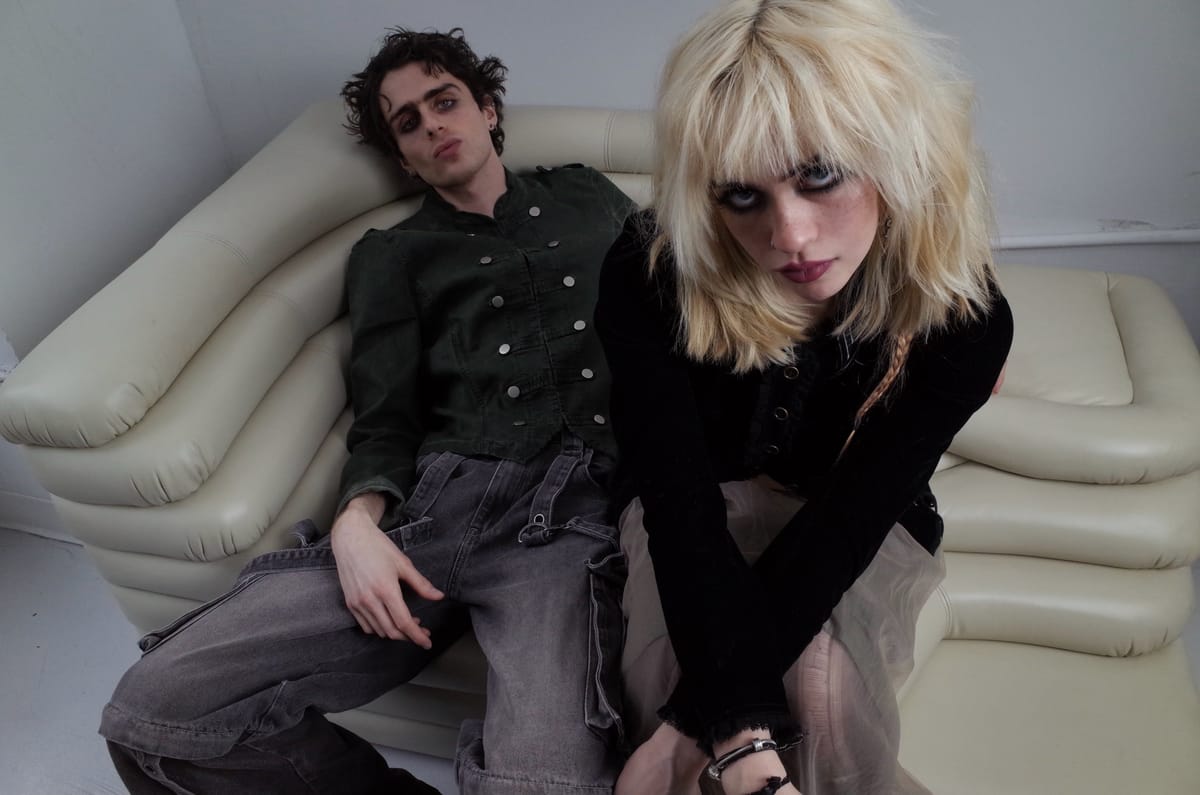
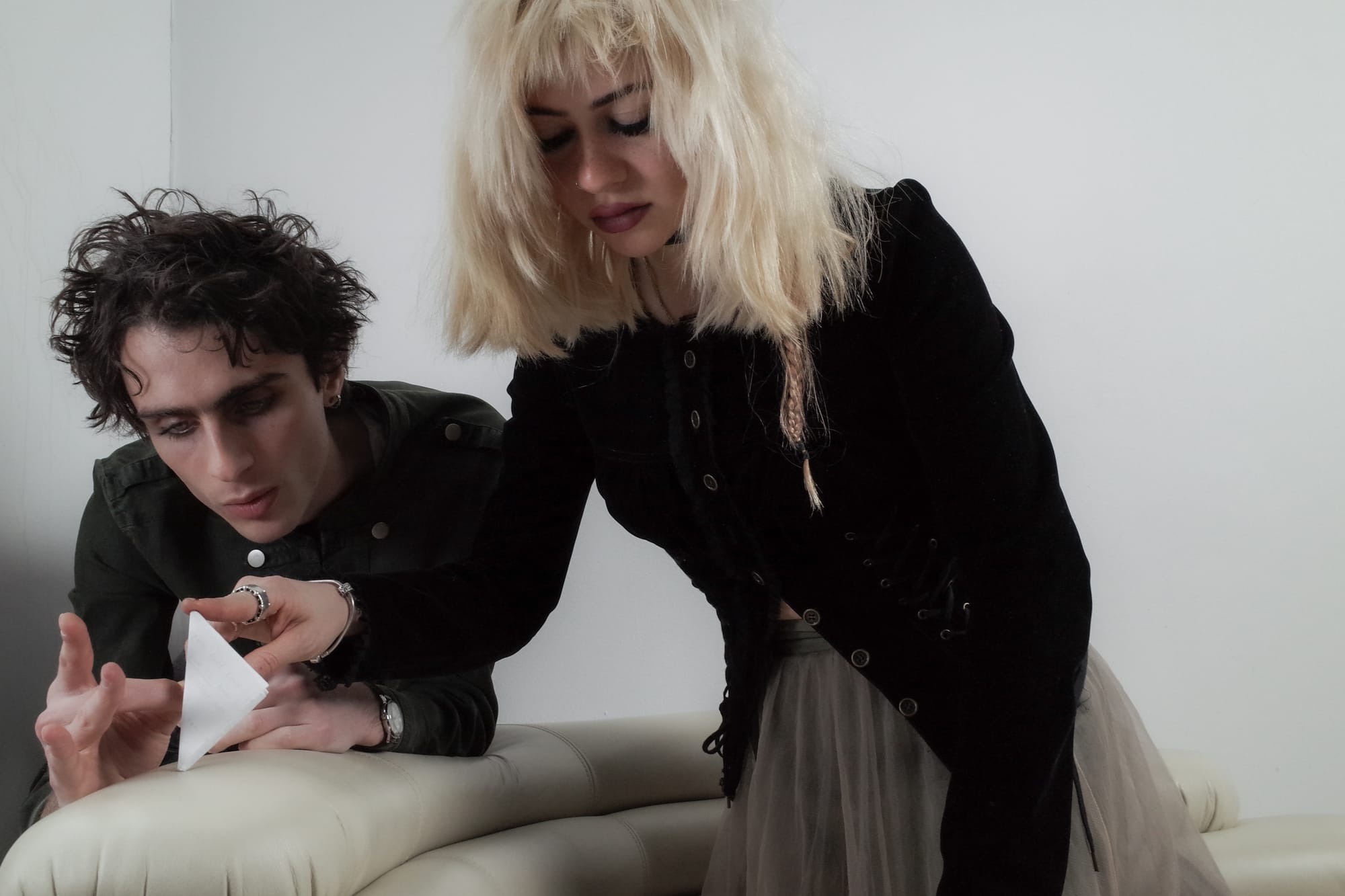
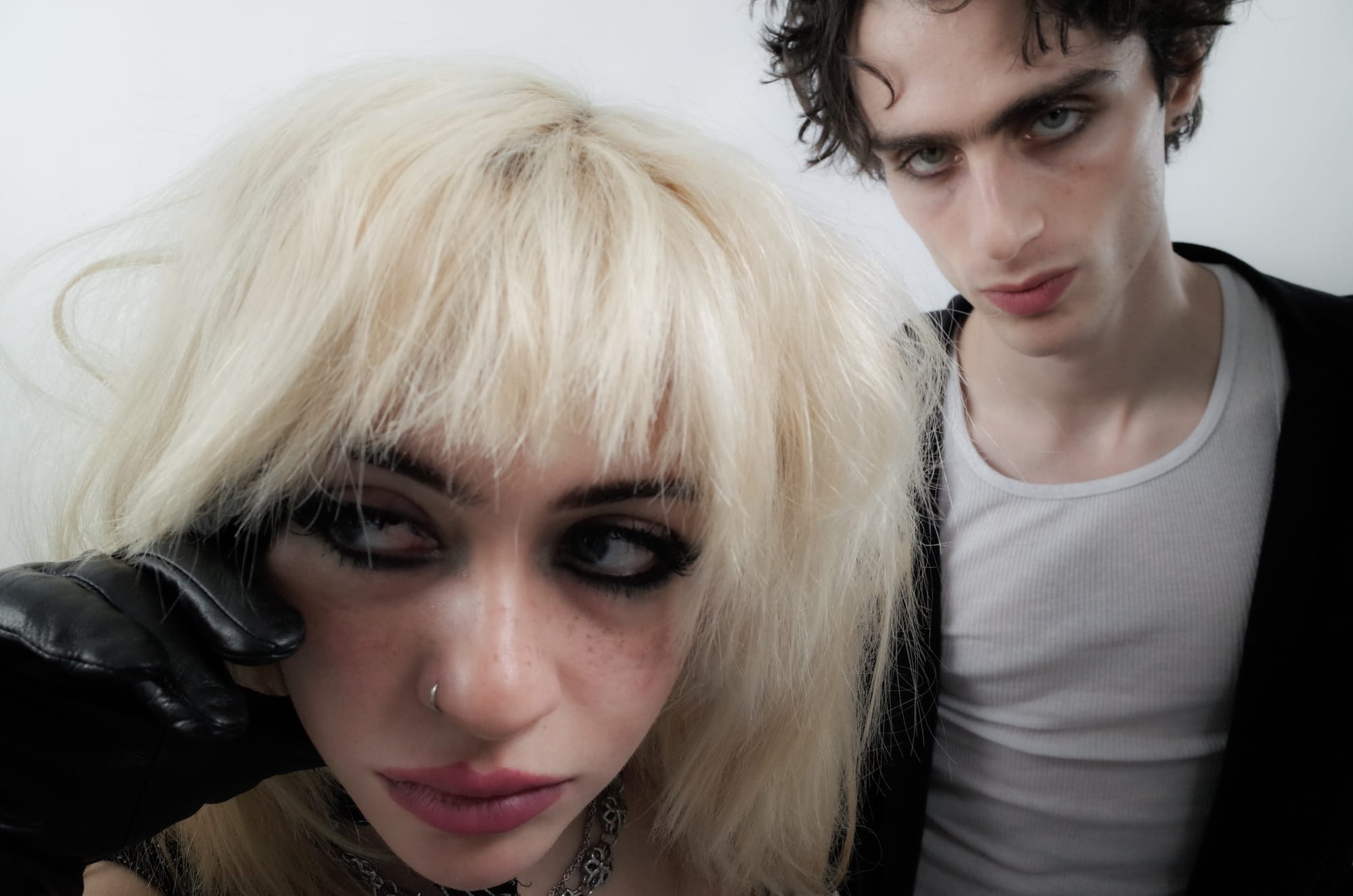
"Atlanta feels like all these outsiders coming together," says Lowertown's Olivia Osby, fiddling with a little duckling charm she wears around her neck and close to her heart while sitting at a café with me during a beautifully ugly day in New York City. The young singer-songwriter, reminiscing on her hometown and the place where she met her best friend and bandmate Avsha Weinberg (who sits inches away from her), elaborates on the city's landscape: "It's such a unique place to grow up because it's an experimental, very liberal, and queer place surrounded by Confederate flags."
"When you're an artist in Atlanta," Osby adds, "it does feel like you're in this group of outsiders that are all doing different crazy things, and you're just together because you're all freaks no one understands, but we all understand and love each other."
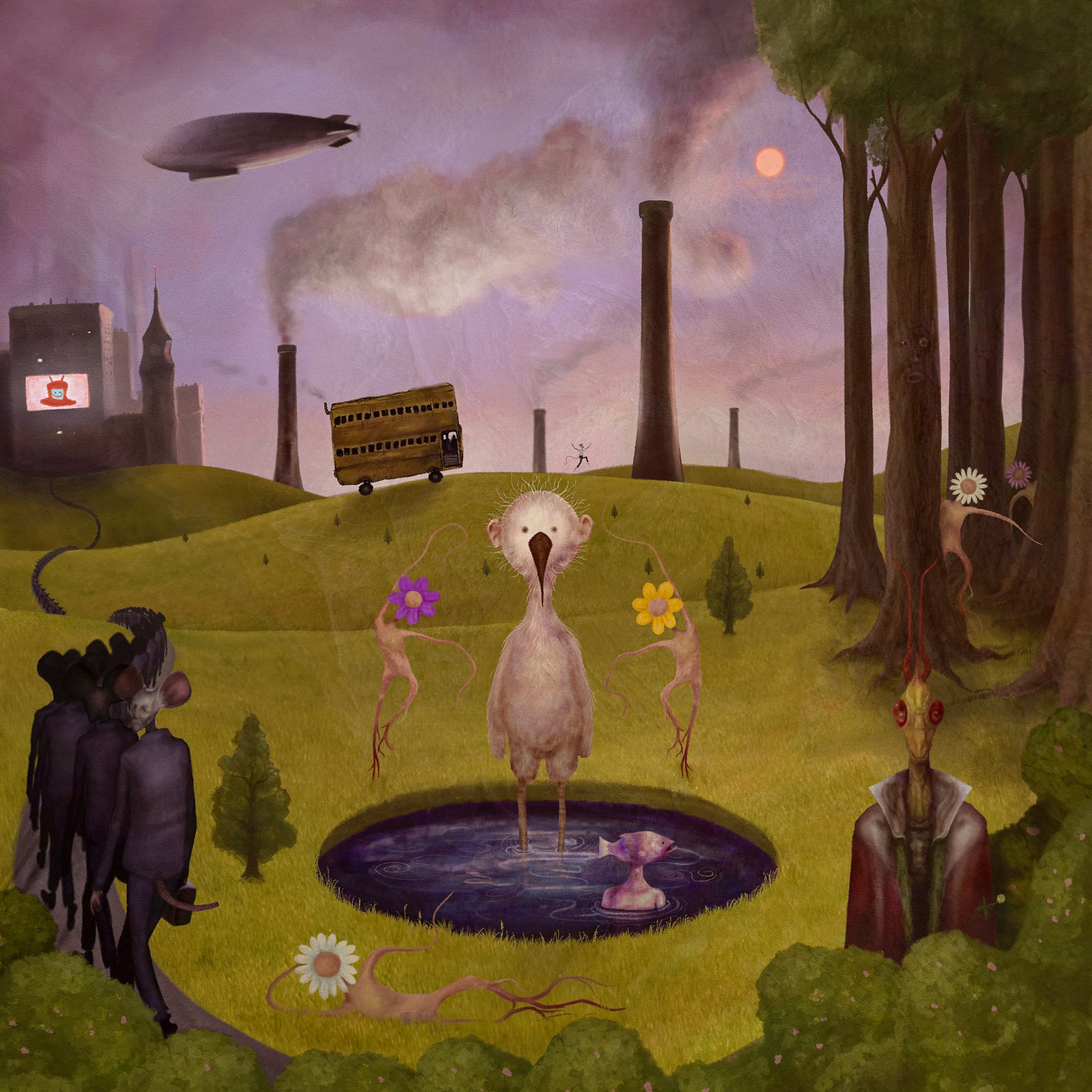
Ugly Duckling Union, Lowertown's third studio album and first under Summer Shade, asserts unabashed friendship. Partly inspired by their breakup with their former label Dirty Hit — a mismatch in artistic vision, they confessed — the alternative duo turned to the popular children's tale to create their own version of little Dale, a duckling who rallies the town's misfits against LBH, a fiction tyrannical media corporation set on separating them to establish control.
"We've been making a comic strip to go alongside the record," says Osby excitedly, telling me about their collaboration with the album's cover art artist, Doctor Nowhere. Lowertown accrued a strong, cultish appeal, maintaining an active on forum for their fanbase and allowing fans' input on the making of the digital comic, as well as becoming a gathering place for misfits in person. "Art is such a beautiful thing to bond over," Weinberg adds. "It's the highest tier of human existence to me." Though he grew up in a lonely place, he later admits, he made his own friends and figured himself out in the Atlanta music scene. "We want to make places where people can do the same thing that we did, especially if they're an outsider. Come to the show, meet somebody like-minded, and maybe you'll find people who you're going to be in a band with."
This spunky, heartfelt attitude embodies the spirit of Ugly Duckling Union, a jagged, Frankenstein-ed album of baroque pop, meditative folk, sweet poetry, feverish punk, and energetic alternative rock. To Osby and Weinberg, it's a testament to their friendship: two impossibly-shaped puzzle pieces fitting together perfectly, harmonizing a guitar and flute solo in the process.
When we met up to discuss the new album, coming out this Friday via Summer Shade, both members of Lowertown pondered the magic of human connection, what it means to be outsiders in an increasingly conformist music world, and what philosophy defines their "ugly manifesto."
This interview has been edited for length and clarity.
Victoria @ TND: Getting into Ugly Duckling Union, I would like to know more about the making of the album and specifically going back to Atlanta to make it. You said you went to your mom's basement to do it; how does the change of scenery going to a familiar place, as well as something that's associated with family, helped to create the album?
Avsha Weinberg: Okay, so the through-line is that we recorded it not totally in Atlanta. We recorded some of it there and the rest at my place.
Olivia Osby: Atlanta was where we recorded the first song of the album [“Mice Protection”].
AW: Yeah, so we recorded it in the Atlanta basement, wrote it there, then we recorded the rest in my basement in Bushwick.
OO: It's comically dingy.
AW: Yeah, it's my really dingy house, and the ‘peeling out’ idea was that it had this basement. We put together this really janky studio there. The first record we ever made [2019’s Friends] happened in the basement in Atlanta, and Ugly Duckling Union felt like a tether to that first album. We didn't have any external powers telling us about due dates, timelines, or anything like that. We recorded it entirely independently. Because we were, again, in the basement, and we were left completely to our own devices, we could just mess around with no kind of pressure, especially with elements of our songwriting that we’re not as comfortable with. For me, it was my first time really getting to sing on this album. It gave us the opportunity to do that again — be as experimental as we were on that first one.
OO: It was honestly just the feeling of being our younger selves and having that spark of creativity. There were so many things in all the previous records that we wanted to do, but we didn't have the time. We were also in a very high-pressure scenario where a lot of people around us were working with us and perceiving us. For me, music is such an internal thing, and it was really nice to be writing from such a comfortable place. Avsha’s basically my twin, so I’m writing from this place of being completely able to do what I wanted without worrying if it's going to be perfect or anything. It all turned out so nice because we got to write so many songs and try and do so many things without being like, “This HAS to be on the record! This has to be perfect right now!” We just allowed ourselves to try a lot of shit.
Right, you guys were really young when you signed to Dirty Hit. And even though it is an independent label, it functions like a major label. They've always been seen as a big label.
AW: Yeah, they function like a major. It’s a very strong institution — a lot of layers of hierarchy and order. Deadlines, for example, were the most challenging for us. [Dirty Hit] gave us a lot of great resources, which allowed us to do things we never could have otherwise, but those systems that were in place didn't allow us to get as experimental as we had wanted to be.
OO: There were a lot of pros and cons…I'm so proud of all those records, and we were able to record with Catherine Marks, who’s an amazing producer. She was such a strong influence and really listened to us as 18-year-old songwriters. She took us very seriously, so it was great for us.
On this record, Ugly Duckling Union, do you consider it a restart in a way?
OO: I think it's more like coming home. It's all the pieces of what we've done previously and expanding upon them, but it also has that playfulness of the first album. What is so beautiful about the first time we wrote music together in Friends is that there was no context for anything, and there was no expectation to be anything at all. It was just for the pure love of making music and finding this thing within ourselves. It was very vulnerable; it was written within the context of our friendship forming.
We wrote Ugly Ducking Union after realizing we were super co-dependent with each other after years of being best friends and working together as bandmates. Avsha’s my best friend, business partner…everything! He’s so intertwined with me where we were one person, and that was not sustainable. We were living together for so long, so we eventually moved out of the house and away from each other in New York.
Ugly Duckling Union felt like a reintroduction to a new phase of our friendship in the band, approaching everything in a healthier, stronger way. When you're in such a big structure, there's so much pressure and you're being perceived all the time. You have no chance to grow. It was nice to just have that time to just be like, “Who are we? What are we doing? What do we want out of this?” Coming back and having all these questions answered in like a different way helped me realize we're doing this because we love making music. I’m doing it with my best friend. This is my life's purpose. This feeling was very uncorrupted by everything else.
AW: Tying it back into Atlanta and going back there, I think the most important influence of Atlanta is more the creative energy that it gave us. It's not a very genre-heavy city. There’s a lot of freaky shit there. And sure, rap is the overarching thing, but there is now a genre-less fluidity to it. When we were with [Dirty Hit], they wanted us to label our music as one thing.
From their point of view, it helps with categorizing for shipment, for pitching, for description…
AW: Yeah, when we started working within a label institution, they were like, “We need to label you guys as something. What are we advertising?” When we first went into music, we thought of it more as a reflection of our friendship. We hadn’t thought about it; it’s just us hanging out. Now that we kind of are out of that label dynamic — or we were out of that when we were recording — the music once again felt like a reflection of who we are and our relationship to each other, being friends for eight years and being in all these crazy scenarios together. It felt like those shackles were broken a little bit.
I'm interested in you two evolving more as individual songwriters. There's a specific part in the album — “(I Like To Play With) Mutts,” to “DIPSH*T” to “Anything Good Takes Blood” — where it sounds like both of you wrote your own version of the same song and then come together and reel it in at the end. How do you find that dialogue energy with each other?
AW: Honestly, those are great examples of what we were just saying. Like, we have infinite time; we can make whatever crazy shit we want. Those honestly were some of the most collaborative songs, even from the beginning. For “DIPSH*T,” both of us were together in the basement in the studio, and that one really felt like how we used to write music. We’d record it at the same time, screaming into the vocals punk-style, and we didn't really have any microphones except for the ones that you’d attach onto a drum kit. It has like this plastic thing on it, and it's really small. We were holding it against our face. I had the guitar part on loop; then we just improvised for probably an hour.
OO: I was obsessed with that drum, which I think happened first. There was something with the drums or the guitar that made me go, “This sounds like ‘DIPSH*T’ to me.”
AW: I had done the guitar, and then I wanted to play it on a keyboard and be really out of time and completely out of control. Then we wrote our lyrics based off of whatever was coming to hit us.
OO: I wrote “Anything Good Takes Blood” — well, the chords to the song and the lyrics. I was obsessed them; these are some of my favorite lyrics I've written in a long time. I took this song to Avsha, and he was like, “This is cool, but we can make this so much more interesting. If you trust me, let's dissect it and rebuild it from the ground-up.” I was like, “…As long as we keep the lyrics, I'm happy!” We recorded the song as is, and I sang over it, and then we completely cut out all the guitars, stripping everything back.
Throughout this whole album, we were thinking more in terms of not what we can do, but more so that every element must be essential. I used to be way more maximalist with music; I was so excited that I could make sounds that sounded good together and add a bunch of shit to them. I was honestly pissed at first to take away the guitars…But now that every instrument on there is important, it's so much better. It's a song I've never written before, and it's one of my favorites because it's so interesting.
AW: I had become really obsessed with African electric guitar-based music. I was obsessed with the environment that it puts you in because it's very repetitive. It'll be 10 minutes long; it's very trance-like. So, that was like my influence for composition: I want to be in the environment. With those three songs in particular, that's entirely environment. They put you into a place completely. They’re less about the intricacies of songwriting, and more… I feel in a crazy way when I listen to this part of the album.
OO: We've been wanting to do more music like “Mutts.” Avsha sent me this instrumental, and I reacted by wanting to make the most challenging song for me to sing ever. I wrote four pages of lyrics and cut them down. That one was one that was really uncomfortable; we both were trying to figure out the dynamic of that. It was a push and pull, as well as the last song we finished for the album.
AW: Yeah, like the others, it’s incredibly improvisational. The instrumental that I sent to Liv has no structure. I just played guitar for fifteen minutes. And then I cut it down.
I know Ugly Duckling Union has a narrative of people coming together, and the themes of loyalty, friendship, and love go in different directions. How did you two decide to map the whole thing out?
OO: One of the biggest lyrical concepts of the album, at least for me, is the light and darkness in every person. When you're younger, you have such a black-and-white view of the world: this is “good” and that is “bad.” These people are “good” — I'm “good” — those people are “bad.” People who hurt me are “bad.” Sometimes it feels like the world is affecting you rather than having an impact and affecting it. That’s at least how I felt when I was younger.
AW: That was a big M.O. of our early music. It was very raw and moralistic, to a degree.
OO: I experienced some micro-ego death moments after we dropped our last record [I Love To Lie]. We just experienced a lot of things that made me shift my perspective on myself, about music, about everything. My whole sense of self and what I built my life and reality on was stripped away a bit. A lot of the lyrics [on Ugly Duckling Union] were me rebuilding my sense of what I even think reality is and who I am. This was the first time I was really grappling with the darker parts of myself and understanding, being able to forgive, and growing from them. I have the ability to hurt people; that doesn't mean I'm a bad person, though. “Worst Friend” kind of gets into that the most.
The trajectory of the album begins bright and light, and it gets deeper, more metaphysical, and more existential as it goes along. I think a lot of the songs in the first half are bright, and they deal with these external things: hanging out with your friends at the bar, hanging out at the park. The second half is deep in a meditative state in your room. It’s a very internal, very withdrawn section; we call it the “magic half” because it feels very magic-oriented.
AW: Even the first song on the album, “Mice Protection,” has that connection to our previous music where we sing, “Maybe I'm good, maybe I'm bad.” Like, it's a lot more straightforward. And then as the album goes along, it breaks that concept down a little bit more, and it becomes a lot more abstract about grappling with these ideas. It's also a reflection of our friendship, too. Most of our music is pretty dark, but we love to be around each other. We laugh a lot, and we want that to be something that is in the music, especially something that's so reflective of who we are.
OO: You need the light so you can feel the dark as heavily as you should!
What I found interesting about Ugly Duckling Union is the big theme of ugliness and the word “ugly.” I was wondering what that specific word meant to you coming into the record, how you felt it throughout the songwriting, and how you wanted to make it more of a natural state of being.
OO: For me, it means a lot of different things. We’ve found that our music is a home for people that feel like outsiders. I've always felt like an outsider, and I love outsider musicians. That's where I find my home, and that's where I feel seen and heard. I value those things almost the most highly in my life. I think we found that a lot of people resonate and reflect those views: our fan base and people that have come to our shows and interact with our art have relayed to us that they feel a home with our art. They’ve found a lot of people that they relate to, that they otherwise would have had a hard time finding.
I feel like there's so much pressure to be perfect and pretty all the time. Well, that’s something everyone can relate to, but it’s especially real for women. I used to feel that so much; I used to be so self-hating. But, the more that we perform, the more I’m literally just not even thinking about myself. The uglier I am, usually the better the performance, the more fun I'm having, the more I'm connecting with people. It’s letting go of this stiffness and this perfection. What is so beautiful about life is like… When you are ugly, when you're not even thinking about how you're looking, there’s a looseness to existence. Ugly is not a bad term to me. I can be this very put-together, hopefully elegant person, but I can also be this messy, extremely out-there, very sweaty, very gross rock star! I love that, and I don't mind that. I think that's the entirety of being a person.
I've noticed that, even at shows — because I sweat horribly, and I will have insane pit stains after we get off stage —a ton of girls would come up to me after and say, “I wasn't gonna wear this shirt today, but you always are repping the pit stain, so I wore my white shirt to the show, and I'm sweaty as hell, but I don't give a fuck!” It's beautiful to not put shame on anything natural. It’s our way of reclaiming it and making it awesome. That's my ugly manifesto!
AW: To me, it's a representation of community to us. Even the story of The Ugly Duckling being one of an outsider’s transformation, I’ve always read it as being appreciated for what you have. I feel like that was what we were always projecting; we were always an outsider band, even when we were put into a bit more of an institution with the label. Even though music in general is much more polished now, people are trying to recreate outsider art and make money off it. That’s so against what outsider music is that people can feel it, and they can know when it’s a profit thing. You can do it with some other types of music, but outsider music is a lot harder to nail down, replicate, and monetize. What is truly outsider music that brings together people who feel like outcasts will always be genuine and in its own world, bringing up its own people.
Ugly Duckling Union channels that idea. It's going to be ugly probably forever, and in that, it's almost untouchable. It'll never really be manufactured or faked, which is important to us. I feel like throughout our career, we've had a lot of people neither understand nor believe in us, and it's like…you actually don't understand our potential. Just that self-belief — what you know you can become and transform into, even when people doubt you — has become super important every step of the way.
What, to you, does it mean to actually pay homage to outsider music, or to immerse yourself in that world?
AW: I think outsider music is so special because of how genre-less it is. It’s so much more focused on the idea rather than anything that you put out. Outsider art is strictly the idea of, “I want to create. I want to express myself so clearly that I'm not going to be impacted by anything else.” It can be pop music, it can be electronic music, it can be completely apart from everything else. It's the only thing that has withstood genre, which even ideas like “popular” or “indie” have been flattened into and assigned to a certain sound.
OO: I think human brains like to understand things within a context, and it makes things easier to understand. Our previous label had a hard time placing us and knowing how to advertise our music; there were a lot of different things going on that weren’t easy to box in something. Outsider music thrives without context, and it’s the most beautiful thing, too, because that means you're the first of what you're doing. Outsider music usually doesn't get its flowers until way after the musicians are dead, or like…your favorite artist is somehow really tapped in and citing them as their favorite. It's lonely to be the first one to do something, but it’s also the fucking coolest! The goal of an artist is to make something lasting and impactful.
AW: Because it’s so prone to being repeated, people have wanted to figure out how to monetize it for so long. But the best they can do is…well, just tell people that this is their favorite artist, you know? If that is genuinely your favorite music, that's awesome! Any visibility to this music is crucial to protecting it. Seeing how huge Daniel Johnston is now is an amazing thing. Like, he deserves it. But yeah, you cannot really make it unless you have that idea. There are pop stars now who came up making outsider art and are getting appreciated.
OO: Bro, Lady Gaga was an outsider. Blood Orange is doing outsider art. Caroline Polachek was doing it forever. She makes really crazy music, and it's so genuinely her, even though it is very clearly pop music.
AW: They all had an idea that’s not easy to grasp or contain. That's my goal as an artist: to make something unique that you can't really box in and moves people. It ideally makes people feel something, good or bad. It's not neutral nor forgettable — that's my worst nightmare.
OO: Also, what makes that kind of art so unexpected is that it comes from that idea of being untranslatable at the moment. People react like, “What the fuck are you doing? This is crazy. I don’t understand it!” I think that's so cool. It's so pure, and I feel like it's almost a subconscious thing. It’s music that’s written before you have all these “safety measures” for making hits built up in your head.
One song that I wanted to get more in-depth insight is “Big Thumb.” You mentioned before that you were really inspired by trance guitar music, and even though it was released as a single, that song almost functions as an interlude of vocal loops and repetitive phrases building tension. Could you talk about the making of it?
AW: I love that song. Liv had become obsessed with 80s industrial music and how the lyrics would be made from newspaper clippings and stuff like that. The way that I was introduced to that was through “Idioteque” by Radiohead. It was written similarly, as they had some lyrics in a fishbowl that they’d pull out randomly.
OO: A lot of industrial music at the time — the chaos magic bands in the UK, in particular —would use magazine and newspaper clippings for the lyrics. That was something I was obsessed with, and I was begging Avsha, “Can we please write a song with clippings that doesn't even have to be in the album at all?” I feel like when you do something long enough, especially as an artist, you fall into your habits of what's comfortable. Like, you fall lyrically into what feels good. I do that all the time, but I never want to make a song that sounds like the last one. If I'm saying the same thing over and over again, what's the point, you know? Anyway, this is what we got to do because we had time. I also really wanted harmonica on this album.
AW: I wrote those three guitar chords while riffing on a 12-string. I was just messing around, playing these three chords over and over again, and we had all these markers and strips of paper around us for inspiration. The song just came out after a fifteen-minute, harmonica/12-string jam. Then we started singing these mantras over and over.
OO: I also love mantra-like songs. I love Panda Bear so much; he writes so many mantras of positivity all the time. I listen to that a lot, especially on tour. He has a song called “You Can Count on Me” dedicated to his son. I would listen to that nonstop on tour and feel super secure and good. It feels so uplifting!
AW: When we're on the road, we have to listen to stuff that doesn't destroy our ears listening to it 40 hours in a row. So, acoustic guitar music, statistically throughout my whole life, is what I've listened to the most. On tours, I really started to appreciate Blaze Foley, John Fahey, John Prine, too. He's got classic pop songwriting, but to me, I get into trance when I listen to his music. When I play an entire album, the concepts are so connected that it feels like you're listening to one really long song. And, you know, we're from Georgia, we’re Southern; it's the music that we grew up listening to. I'm only going to play these three chords, and I'm going to dumb it down a lot.
OO: That’s hard for you to do! You don't like to be dumb with it.
AW: But I thought it was so much fun! Liv, you were really feeling yourself with the harmonica playing at the same time!
OO: I wanted to play harmonica so badly on the last record. I also wanted flute on the last album, but we got to do both this time! We got to do all these things that we've been wanting to do so badly, which was so sick.
AW: Yeah, the song feels like us. It's our relationship together; it's how we have grown in the last ten years.
I was actually going to ask about the flute. Because the track “Cover You” plays like two songs in one. You have a folk guitar with the lyrics, and then you split it up with that flowery, baroque pop flute melody. What was the stylistic choice you made for that one?
OO: We were just doing our own thing and not worrying about making it structured. I wanted flute on our last album so badly, so after we dropped I Love To Lie (2022), I learned to play it. Avsha had this beautiful guitar part, and I put flute on top, and we ended up writing an instrumental part that became such a sweet, beautiful song without words! I wanted to make another one with lyrics because we don't write sweet music that much, and this was our challenge to approach music from a place of joy, community, and happiness. I think I was in a relationship at the time, and I wanted to write a song like the one Panda Bear wrote for his son, channeling, “I will protect you and love you.” I wanted to write songs that were making me feel good… Whenever we perform, I always go back into the headspace of when I wrote the song, and it's tiring to only perform sad or angry songs because I'm feeling so crazy after I get off stage.
AW: I actually love the song construction of that one because I had written the guitar when I was feeling absolutely terrible. I always play guitar when I'm feeling really bad; I'll have a TV show playing, it'll be really late at night, and I’ll just be fingerpicking forever. I had written the fingerpicking on the classical guitar during a really, really negative moment for me, but I wanted to feel nostalgic and sentimental about it. When Liv came with her lyrics and the really sweet melody, I felt like the contrast of these two parts was so honest. She came at what was a really dark song for me with such a beautiful, joyful attitude.
OO: That's the beauty of writing separately: we come together in completely different contexts. I ended up getting you to arrange that one sort of like a Philip Glass song. We were also obsessed with Philip Glass.
AW: I was NOT obsessed with Philip Glass. I do not fuck with Philip Glass at all. He's got a lot of concepts going on... I like “Floe” a lot, and I like some of the Glassworks stuff. We listened to “Floe” a lot in high school.
OO: I think we arranged that one sort of like that. I would play all these different motifs, and we would have them interweaving in and out. It just reminded me of being in high school because I allowed you to conduct me, which was really cool.
AW: I have a classical upbringing, so I love any opportunity that I can do composition stuff like that. It feels really fun.
Did that influence the decision to end on an instrumental track?
OO: We've done that for all our albums. Our first-ever album ended with a piano track, and then on I Love to Lie, it was also a guitar.
AW: Ugly Duckling Union didn’t even have one at first, but I was like, “We have to have an instrumental closure! We always do it!”
Narrative-wise, it’s almost like a cool-down — a conclusion to this whole journey that you go through. It’s sort of like settling down and processing everything.
AW: Honestly, I liked that it was a return to form in our first album. I felt like Ugly Duckling Union needed something to tie it all together in a closure moment. The way that we started making music together was that I showed Liv a bunch of demos. I had instrumental demos that had a similar songwriting style to all the instrumental ends of each album, as well as all the pretty piano and guitar that ended up becoming Friends. Every time we have an instrumental ending, it feels like a reference to the first time we started making music. It's always pretty simple instrumental stuff; it's never too many layers or anything complicated. It could be what you listen to all the time. That was the thing that initially connected us as songwriters and musicians, and as friends.
OO: It showcases a part of the musicianship that isn't showcased as much with the other songs. But, it’s such a big part of you and our dynamic, that it's really nice to include it. It’s the whole picture of us.
'Ugly Duckling Union' by Lowertown is out this Friday, May 22 via Summer Shade. Pre-order here. Lowertown are currently on tour in the US.
The Needle Drop may earn an affiliate commission via purchases on ticket links through this article.
What do you think?
Show comments / Leave a comment