

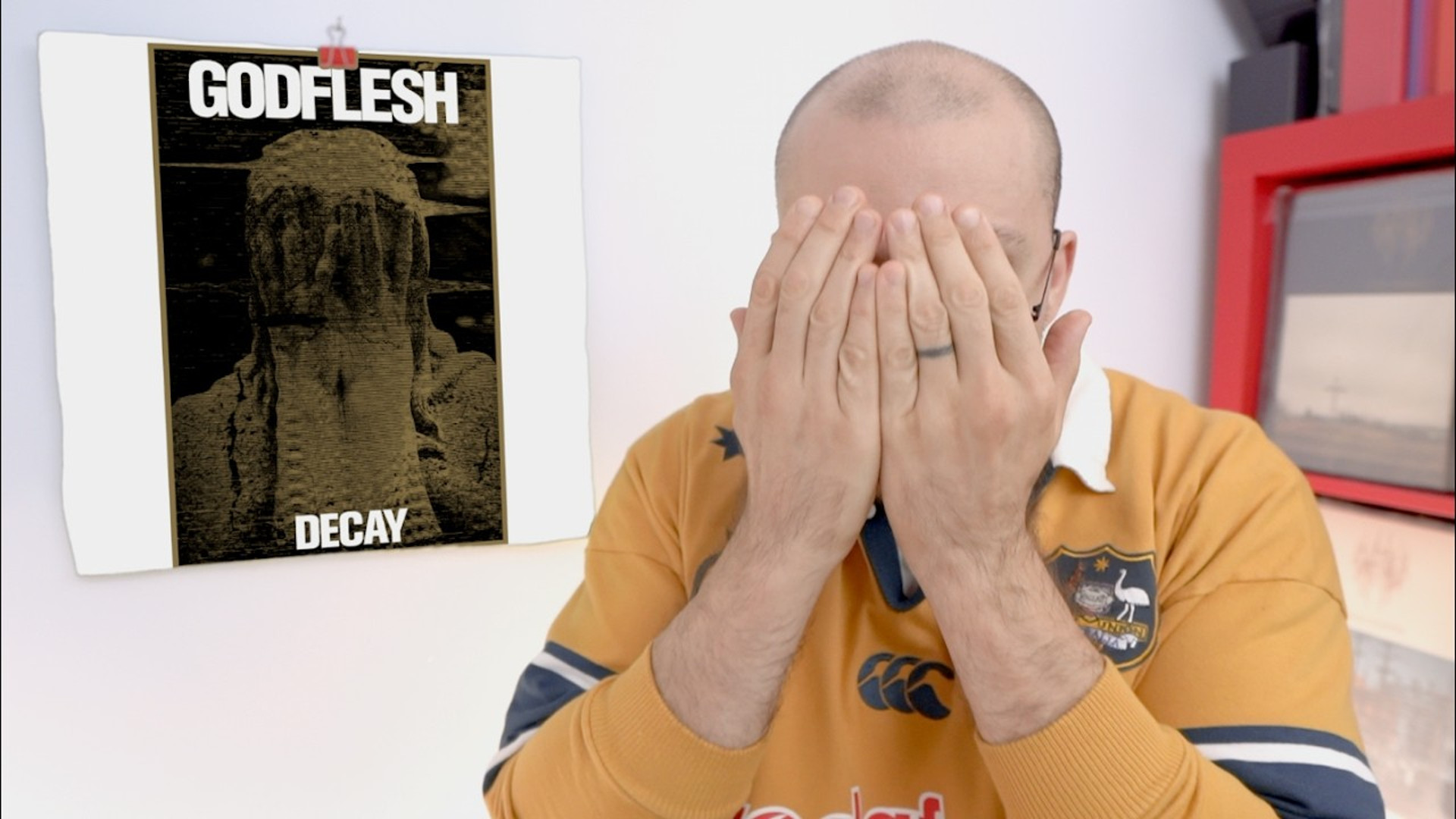
Hi everyone, Thethony Endtano here, the internet's busiest music nerd, and it's time for a review of this new Godflesh album, Decay.
Here we have the tenth full-length album from legendary industrial music project Godflesh, which since its inception has been masterminded by guitarist and metal pioneer Justin K. Broadrick.
And this album arrives at a very interesting time in the Godflesh trajectory. I mean, to start, we are currently over a decade out from Godflesh returning from a pretty lengthy hiatus that started in the aughts, and ultimately resulted in three albums that, by Godflesh standards, were fine, decent, maybe got a bit more experimental toward the end with Purge, but for the most part, these records were not holding a candle to the initial run of Godflesh albums in terms of creativity, novelty, boldness, crushing, raw, exciting guitars, namely on records like Streetcleaner and Pure.
And these are albums that in so many ways would kind of set the gold standard for industrial metal in the underground and inspire countless offshoots and other albums, even today. But what initially led Broadrick to put Godflesh to the side to begin with was a combination of differences between Justin and co-founder G.C. Green over the shape the music had been taking and the direction of their careers as Godflesh, combined with some pretty significant turbulence in Justin's personal life at the time.
And to a degree, Justin's own disillusionment with, the direction the music was going in because Godflesh's 2001 record, Hymns, for sure took a very different shape from albums past, considering, it had professional grade studio production, live drums, and a lot of riffs and grooves that, to me, hold, many parallels with a lot of modern and mainstream metal music at the time, which in some contexts, I think, could be seen as maybe too much of a departure, even if, personally, I like that album and think it has aged, incredibly well.
Still, all of these factors led to Broadrick putting his creative focus elsewhere for years, namely on another project that goes by the name of Jesu, which also brought a lot of heavy guitars and mixes to the table, but took a much more mellow and abstract approach, bringing in elements of drone and shoegaze music as well.
Under this name, it's no surprise that Justin would also collaborate with ambient artists and make a lot of music that is kind of tagged under the post-metal categorization. Now, despite the fact that these different projects have been led by pretty much the same guy for the most part, they've always existed in very different spaces, musically and aesthetically, and in a way, I think this new Godflesh album asks, why? Why does it have to be that way?
Now, of course, there's a bit of a contextual backdrop to this fuck-it attitude, as Justin's creative restlessness, I think, combined with the age of the project and what's said to have been some pretty major abdominal surgery recently, put things in a place where he wants to put the Godflesh project to bed for good, topping things off with a forthcoming album titled The End.
But before we get to The End, we are first going to hear Decay, and this album, obviously, having been kind of assembled and at least in part, tracked and recorded with the knowledge that we're going to be bringing Godflesh to a close. So we're kind of doing a two-part finish here, if you will.
And Decay over here, like any return Godflesh album we have heard so far, basically says, to start, let's check those basic Godflesh boxes that make a Godflesh album what it is. You've got those sequenced drumbeats; you've got the distorted, heavy, grinding bass, gargantuan, groovy riffs as well. But then, in addition to that, ask: why don't we do some surreal and kind of trippy vocals? Add some spacier atmospheres along with some more moody and apocalyptic guitar passages. Effectively adding more layers and flavors and post-metal textures to kind of those trademark crushing Godflesh riffs.
Not to mention some of the sounds play out in an opener and a closing track that are eight and 11 minutes respectively, a tad bit longer than your average Godflesh song for sure. And the opener "Master and Slave" kicks things off with kind of a huge contrast, gradually moving from these pounding, slow, roaring riffs to oceanic, seamless, droning walls of guitar that sound fitting for a horror movie soundtrack. And while I'm not necessarily crazy about the slow, downward progression that we take in order to get there, the textures, grooves, and production are all great.
After this, though, Godflesh effectively kicks into high gear with several other shorter songs, "Living/Ending" being one which is backed with lots of guttural bass notes, electro grooves that are kind of hammered out with rock drums, and a lot of dismal, enveloping guitar work that's kind of punctuated by these skittering hi-hat rhythms. The track is a beautifully hideous racket that leaves me feeling like I don't know whether or not to basically douse everything I own in gasoline and light it ablaze, or hit the dance floor on Goth Night.
After this, "Feral Colony" brings a much more persistent and tension-building beast. With lots of gnarly, droning, twisted guitar layers that, honestly, I never want to unravel. And there's a stellar Part B on this track, too, that's punctuated by droning guitars, ringing ghostly post-metal tones, and some bassy, head-nodding beats as well.
"Fear of Man," though, goes way harder on the percussion side with some big, clunky rhythms, and lyrics that literally read like the internal monologue of a man who struggles with interpersonal communication, maybe even eye contact. And again, this is just just, one more moment on the record where I have to give it to Justin's production chops. Because despite every section of this track sounding so heavy, every moment is distinct from the next. And the additional punch of reverb on the vocals makes them so much more psychedelic.
Then "Fodder" is handily the most experimental track of this, shorter bunch, with these twisted, ugly, metal slide guitar passages kinda creeping slowly up and down the neck against these pounding beats and throaty, creepy vocals that have almost a black metal tone to them. The ending is a little unceremonious, but I can definitely commend this track for being as adventurous as it is under the Godflesh umbrella.
Then the closing track is the biggest of the bunch; as I said earlier, at 11 minutes, it's the song "Consume Me." And for a moment, this one, too, feels like it's undergoing a progression that is very similar to the opener, in terms of it being very gradual, kinda putting you into this lull, and kinda coasting downward, that is, until it hits complete silence and returns with a vengeance, only to hit you with the loudest and most crushing riffs on the entire album that are backed with this heavy, deep, druid-type drone. Making for a combination that sounds like, essentially, Sun doing an industrial metal record. And considering the peak it eventually builds up to from here, I gotta say it's one of the loudest and strongest finishes of any Godflesh album so far.
So even if the Godflesh comeback albums that we've heard up until this point have more or less been passable. It seems like Justin and G.C. Green are really trying to end things on a high note now that they are able to more consciously bring things to a close and plan it out in a way that is, I guess, most ideal for them, in terms of creativity and timeline, too. And honestly, I would say this is the first Godflesh album we have heard since the comeback that actually does approach some of the earlier and classic material, in terms of genre fusions, in terms of uniqueness, in terms of heaviness, and also intricacy.
The track list is really solid as well, and from here, I guess, I can only hope that The End is able to build on what Decay is doing, and really finish Godflesh off with a bang. Which is why I'm feeling a light eight on this one over here.
Anthony Fantano. Godflesh. Forever.

What do you think?
Show comments / Leave a comment